Category: Corporate Visionaries
Divya Kumat sees governance as the test of maturity under scale. Systems can be designed, but integrity must be practiced, visible in how decisions are made, risk is judged, and responsibility is carried under pressure. Contracts anchor continuity, people determine integration, and global coherence comes from shared principles, not uniform rules. As technology expands risk, ethics must be embedded at the design stage.
When Scale Begins to Test the Institution: Divya Kumat on Why Systems Can Be Designed But Integrity Must Be Practiced
IndiSight Editorial
Mar 23, 2026

Divya Kumat
Executive Vice President, Chief Legal Officer & Company Secretary · Datamatics Global Services Limited
Mumbai
A company usually notices its growth long before it notices the weight that growth brings. The first shows up in markets, numbers, and reach. The second appears in contracts, decisions, accountability, and the growing strain placed on judgment. At some point, success stops asking for more effort and starts asking for more maturity.
That is the stage when governance begins to matter in a very different way. It starts shaping whether the institution can carry its own complexity, whether standards can survive speed, and whether trust can deepen as the enterprise becomes larger, more distributed, and more exposed to consequence. The strongest companies increasingly distinguish themselves through what they build and through the seriousness with which they govern what they build.
This is the field in which Divya Kumat has built her work over more than three decades. As President, Chief Legal Officer & Company Secretary at Datamatics Global Services, she works across a multinational operating system where contracts, acquisitions, board responsibilities, litigation, intellectual property, employment structures, data obligations, and technology accountability continuously intersect. In that environment, governance cannot remain paperwork, review, or procedural oversight. It has to function as an internal discipline that influences how the company decides, how it interprets risk, how it allocates responsibility, and how it preserves trust while scale keeps introducing new points of pressure.
That is what gives Divya’s work relevance far beyond the legal profession. She has treated governance as part of the operating intelligence of the enterprise itself, as a force that shapes whether growth can remain credible, and as a standard by which an institution reveals its quality under strain.
“Governance is not about restriction. It is about character,” Divya says.
The idea reaches into the quality of leadership, the seriousness of internal standards, and the degree to which systems influence conduct and shape it in practice. It asks whether the enterprise carries its principles into difficult decisions or reserves them for policy documents and annual declarations. It asks whether power inside the company is exercised through responsibility. It asks whether standards remain intact when commercial speed, cross-border exposure, and technological acceleration begin to test the institution from multiple directions at once.
Character Before Process
Much of Divya’s philosophy rests on one principle that captures the limits of modern governance with unusual precision.
Systems can be designed, but integrity must be practiced
Policies, committees, escalation mechanisms, control structures, and audit trails create the possibility of discipline. They do not guarantee it. Institutions weaken when leadership mistakes formal architecture for internal seriousness, or when compliance is treated as evidence of maturity rather than one component of it. Process can exist without conviction. Documentation can exist without accountability. Governance can appear complete on paper while remaining fragile in practice.
Divya’s standard is far more demanding. For her, governance should strengthen the institution while business is being conducted. It should improve the quality of judgment before error hardens into loss, increase accountability before a lapse becomes habitual, and protect trust before trust is forced into repair. That is a very different expectation from the one many companies still apply, where governance enters the room mainly when something has already gone wrong or when disclosure must be produced after the fact.
Her own work reflects that difference. “We positioned that the legal department who is managing the governance should not be treated as a compliance burden,” Divya says. The importance of that shift is strategic. The legal and governance function acquires real operating relevance only when the business experiences it as a source of clarity, sequence, and quality. Once governance is brought into the structure of execution itself, it begins to affect the quality of growth rather than simply monitoring the consequences of growth.
A serious institution earns credibility when governance enters the bloodstream of decisions. That is the level at which Divya has worked.
What Strong Institutions Quietly Measure
When asked which governance indicators most reliably predict business performance, Divya did not reach for abstractions. She named two realities that many companies underestimate until cost, delay, or dispute make them impossible to ignore. The first was contract governance. The second was integration discipline.
Contracts are the bloodline for any organization.
That phrase is exact. Contracts hold revenue logic, obligation structure, liability allocation, intellectual property ownership, exit design, and commercial continuity in one place. If review becomes fragmented, if negotiation records disappear into private inboxes, if approval pathways become informal, or if executed documents are difficult to retrieve, the organization begins carrying risk in silent form. Revenue can be delayed. Liability exposure can widen. Ownership can become vulnerable. Business teams can make commitments whose full implications surface only later, often when the cost of correction has already increased.
Divya’s response has been to insist on structure through systems rather than through personal memory or heroic individual effort. At Datamatics, agreements move through defined workflows, are electronically stored, and remain retrievable across long time horizons. “If you ask me for any contract from 20 years back, it is a click of mouse away,” she says. She is describing institutional memory. A serious company cannot allow its obligations and approvals to survive only inside individual recollection or departmental fragments. Those things must live inside a durable, searchable system that can carry continuity through growth, acquisitions, and leadership transition.
The second indicator, integration discipline, reaches into an equally decisive part of enterprise life. Companies often invest enormous strategic energy in getting the deal done and much less managerial energy in ensuring that the institution created by that deal can function coherently afterward. Divya has been involved in more than twenty-five mergers, acquisitions, restructurings, and joint ventures, and her conclusion is sharpened by repetition across these experiences.
The most critical due diligence is not financial or legal. It is people due diligence.
This is one of the most important ideas in her body of work because it identifies where value is frequently lost without being immediately seen. A target can look strategically attractive, operationally complementary, and financially sound while still carrying human conditions that will degrade the logic of the transaction after integration begins. Leadership temperament, promoter behavior, managerial transparency, and the emotional experience of the acquired workforce shape whether the combined institution can actually sustain the promise of the deal.
“Numbers will always tell us performance. But people will tell us sustainability,” Divya says.
Performance can be measured quickly. Sustainability is discovered through trust, managerial continuity, and the legitimacy employees feel inside the new structure. “If they begin to feel subordinate rather than integrated, the value erosion will start silently,” she says. Communication has to begin early. Local leadership needs visible continuity. Harmonization requires rhythm, not imposition. Institutional respect is a value-bearing asset.
Divya’s M&A philosophy therefore enters the larger domain of business wisdom. It asks leaders to take the human architecture of transactions as seriously as the strategic architecture of transactions.
Global Coherence Demands Precision
The multinational governance problem is often mismanaged through excessive centralization. Standard templates look efficient. Uniform language creates a sense of order. The center feels safer when everything appears aligned. Divya’s experience has led her to a more disciplined understanding.
“Consistency does not mean uniformity,” she says.
That distinction sits at the center of her global operating philosophy. Datamatics works across jurisdictions whose differences extend beyond legal drafting into labor systems, privacy expectations, consultation practices, documentation norms, regulatory interpretation, managerial pace, and the social assumptions behind fairness and authority. An institution that confuses sameness with coherence may feel internally tidy and still generate external friction in multiple markets.
Divya’s answer has been to establish a common ethical spine while allowing local execution to respond intelligently to context. “What is important for you? It’s ethics, transparency, fairness, accountability and respect for diversity,” she says. Those are the constants. Their application evolves according to geography, regulatory environment, and local professional culture. “Governance must be principle-driven. But we must be aware of the local jurisdiction norms,” she says.
This is one of the most serious lessons in multinational leadership. Legal literacy alone is insufficient. Cultural intelligence matters equally. A company can satisfy formal requirements in a market and still misread the managerial and social logic of that market badly enough to produce mistrust, weak adoption, and operating confusion. Divya’s framework preserves moral coherence without flattening local realities into centrally designed abstractions. In a fragmented global environment, that is a source of strength.
Judgment Under Commercial Pressure
Leadership ideas acquire weight only when they survive pressure. Divya’s work under commercial strain shows that she understands governance as disciplined judgment rather than procedural reflex.
Documentation matters. Evidentiary rigor matters. Methodical process matters. Yet these elements become fully useful only when they are combined with interpretation, sequence, and strategic intelligence. In difficult matters, clause reading alone will not carry the institution through. The organization has to think ahead, preserve discipline over time, and hold standards when delay, asymmetry, or fatigue begin to test the quality of its will.
Integrity is not about confrontation. It is about conviction.
In her frame, conviction is the discipline to remain rigorous when the process becomes expensive, slow, or inconvenient. It is the refusal to lower standards because pressure has increased. “Size does not define credibility. Conduct does, perseverance does, patience does,” she says. That insight applies far beyond litigation. It belongs equally to negotiation, regulation, acquisition strategy, and any operating context in which institutions face unequal conditions.
Pressure exposes whether standards are structural or decorative. It reveals whether patience survives once immediate convenience would reward retreat. This is why Divya’s contribution reads as business wisdom rather than domain expertise alone. She has built a practical philosophy of how institutions should think under strain, and that question now sits at the center of serious leadership.
Technology Has Expanded the Meaning of Stewardship
Artificial intelligence, algorithmic outputs, intellectual property exposure, automated decisions, and data concentration have widened the burden of governance materially. Divya has been among the early voices insisting that institutions cannot rely on law alone to define responsible conduct in this territory.
“When technology evolves faster than regulation, companies cannot rely only on law to define the guardrails,” she says.
Her method begins with structured impact assessment. Before deploying emerging technologies, organizations should ask what data is being used, who could be adversely affected, where bias or intellectual property exposure could arise, how cybersecurity vulnerabilities might enter, and whether outputs can be meaningfully audited and reviewed. These are operational questions with institutional consequences. They determine whether the enterprise is governing capability with seriousness or merely using capability with optimism.
“Ethics must be embedded in the technology life cycle,” Divya says.
This principle gives her framework its depth. Privacy by design, security by design, responsible AI by design, human oversight where consequences are material, periodic review of high-risk systems, and incentive structures tied to ethical performance become part of the operating fabric of the company. Technology responsibility enters the design stage rather than arriving later as an apology or a corrective memo.
Her thinking on data stewardship extends the same argument. “Organizations act only in a fiduciary capacity, only as trustees or fiduciaries of that data,” she says. The shift here is profound. Data becomes a stewardship obligation. Accountability reaches into machine-shaped outcomes and design choices made long before public scrutiny arrives.
Executive Discipline as Decision Infrastructure
One of the most distinctive parts of Divya’s worldview is that she treats personal discipline as part of leadership infrastructure. When asked about longevity, her answer began with health.
Longevity in leadership is not sustained by ambition alone. It is sustained by one factor and that is discipline.
This response reframes executive endurance with unusual seriousness. Divya exercises consistently and at high intensity, often six to seven days a week, and she treats strength work, running, breathing practice, nutrition, and meditation as conditions for sound decision-making. Her logic is direct. Senior leadership imposes sustained cognitive and emotional load. Poor physical condition weakens focus, patience, resilience, and judgment gradually yet materially.
“Mental clarity and strategic judgment are deeply connected to one factor, that is physical well-being,” she says.
This gives her leadership philosophy additional force because it shows that judgment depends on disciplined self-management as much as on professional experience. Institutions speak often about resilience while building routines that quietly erode it. Divya’s standard is more demanding. Endurance is maintained through routine. Decision quality depends on how seriously leaders govern themselves, because the self is also part of the decision system.
A More Serious Curriculum for Leadership
Toward the close of the conversation, Divya was asked what she would include in a curriculum for the next generation of leaders. Her answer offers the clearest distillation of her worldview: judgment, risk, and responsibility.
“Judgment is not same as intelligence,” Divya says.
She defines judgment as the ability to decide under uncertainty, with incomplete information, without becoming captive to pressure, perception, or siloed thinking. Young leaders need exposure to real cases, failures, regulatory actions, and lived complexity if they are to build that capacity. Academic strength, by itself, will not produce it.
“They should think in scenarios and not in silos,” she says.
That statement widens leadership beyond formal role descriptions and asks future leaders to understand consequences across functions, reputational exposure, and human outcomes rather than only through the lens of their immediate domain. Her view of risk is equally disciplined. “Risk is not something to eliminate but to mitigate,” Divya says. Serious institutions cannot remove risk. They can understand it, weigh it, and manage it with rigor.
Then comes responsibility. “Ownership does not end with accepting the task. It ends only with delivering it to its logical execution,” she says. This is a demanding definition because it refuses the managerial habit of confusing effort with completion. Taken together, these three ideas form a serious leadership curriculum, one that applies across operators, founders, investors, technologists, board members, and policy leaders alike.
Leadership Lessons
Governance is not about restriction; it is about character, and character reveals itself under pressure.
In acquisitions, the most critical due diligence is not financial or legal; it is people due diligence.
Contracts are the bloodstream of any organization; ambiguity today becomes litigation tomorrow.
Numbers may show success today, but people decide whether it survives tomorrow.
Consistency in global organizations comes from shared principles, not identical policies.
True leadership is stewardship; safeguarding capital, people, data, and trust that ultimately belong to others.
Integrity matters.
Not every battle needs a courtroom victory; sometimes the wiser outcome is resolution.
In the age of AI, boards must govern algorithms with the same discipline as financials.
Accountability cannot be outsourced; leaders own both outcomes and consequences.
When technology evolves faster than regulation, companies cannot rely on law alone to define the guardrails.
Physical well-being, often neglected by leaders, is fundamental to mental clarity and sound strategic judgment.
The Standard Beneath Scale
Divya’s significance lies in the standard she represents. She shows that governance, interpreted with seriousness, becomes one of the deepest forms of business leadership because it shapes the conditions under which institutions earn trust, absorb complexity, preserve quality, and continue to make sound decisions as they scale.
The next generation of strong institutions will not be distinguished only by how fast they grow or how well they adopt technology. They will be distinguished by whether they can hold judgment inside scale, principle inside velocity, and responsibility inside increasingly complex systems.
Divya has spent more than three decades working in exactly that space. The three disciplines she returns to at the end, judgment, risk, and responsibility, are not occasional talking points for leadership rooms. They are the conditions through which institutions remain worthy of the scale they achieve.
That is the standard beneath scale. That is where the most serious form of leadership now resides.
Our Suggestions to Read
Discover The Leaders Shaping India's Business Landscape.
Founders & Innovators
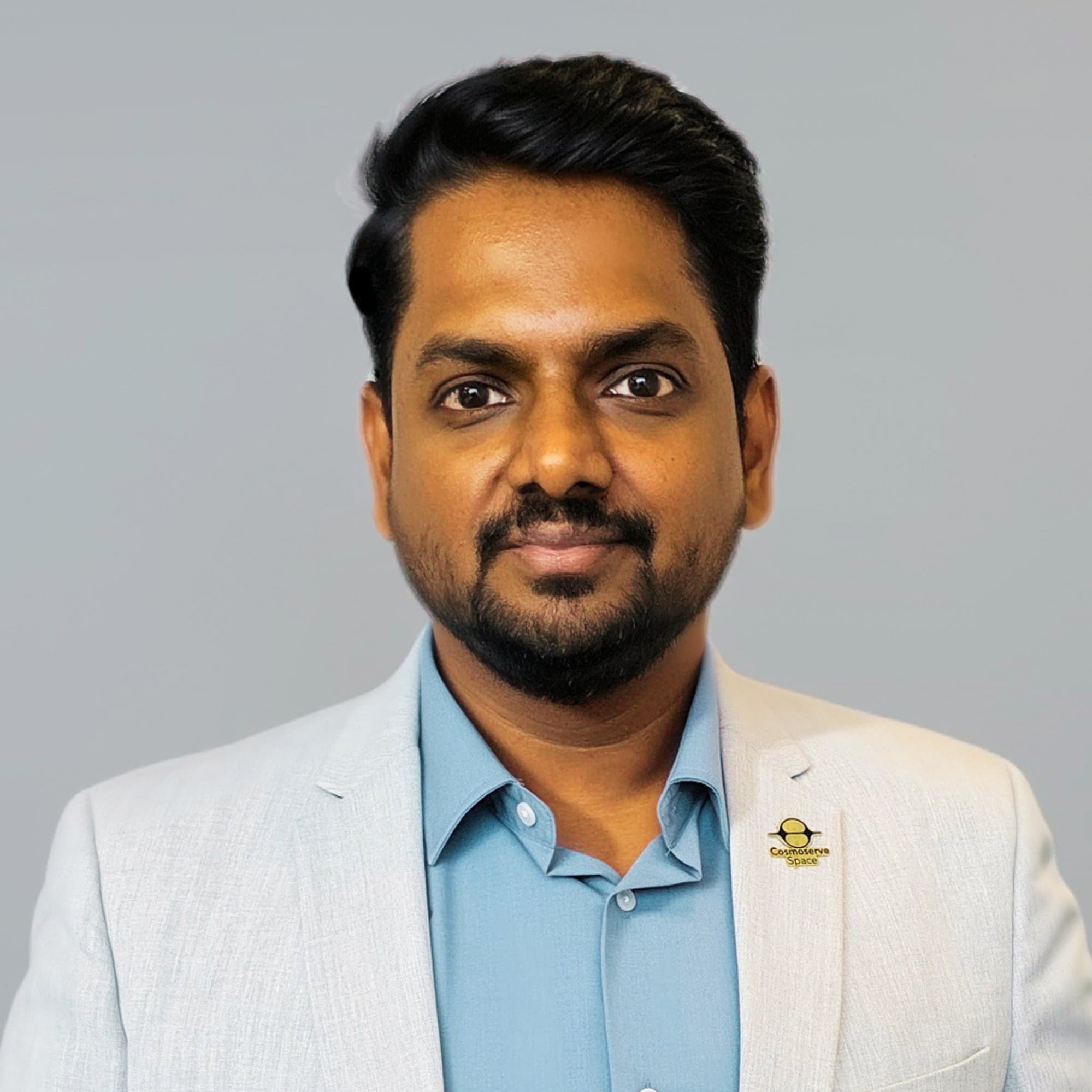
Building the Next Space Economy: Chiranjeevi Phanindra and Cosmoserve's Case for Orbital Maintenance
Chiranjeevi Phanindra, Founder & CEO of Cosmoserve Space, spent 14 years at ISRO working on re-entry and human spaceflight. Today, he is focused on a vital challenge: keeping Earth’s orbit usable.
Read Full Story

Corporate Visionaries
Shashank Sahni on What Success Leaves Out
Shashank Sahni, Google’s Managing Director of Global Ads Solutions, reflects on what customers reveal, what ambitious teams need from their leaders & what the mountains and marathons have taught him about going further.
Read Full Story

Corporate Visionaries
Clinical Multiplication: Divesh Singla on the Healthcare AI Case That Headlines Keep Missing
Divesh Singla, Managing Director, India at Veradigm, brings two decades in healthcare technology to the AI question leaders cannot avoid: how to expand clinical capacity without weakening human judgment.
Read Full Story