Category: Founders & Innovators
Chiranjeevi Phanindra, Founder & CEO of Cosmoserve Space, spent 14 years at ISRO working on re-entry and human spaceflight. Today, he is focused on a vital challenge: keeping Earth’s orbit usable.
Building the Next Space Economy: Chiranjeevi Phanindra and Cosmoserve's Case for Orbital Maintenance
IndiSight Editorial
Oct 5, 2026
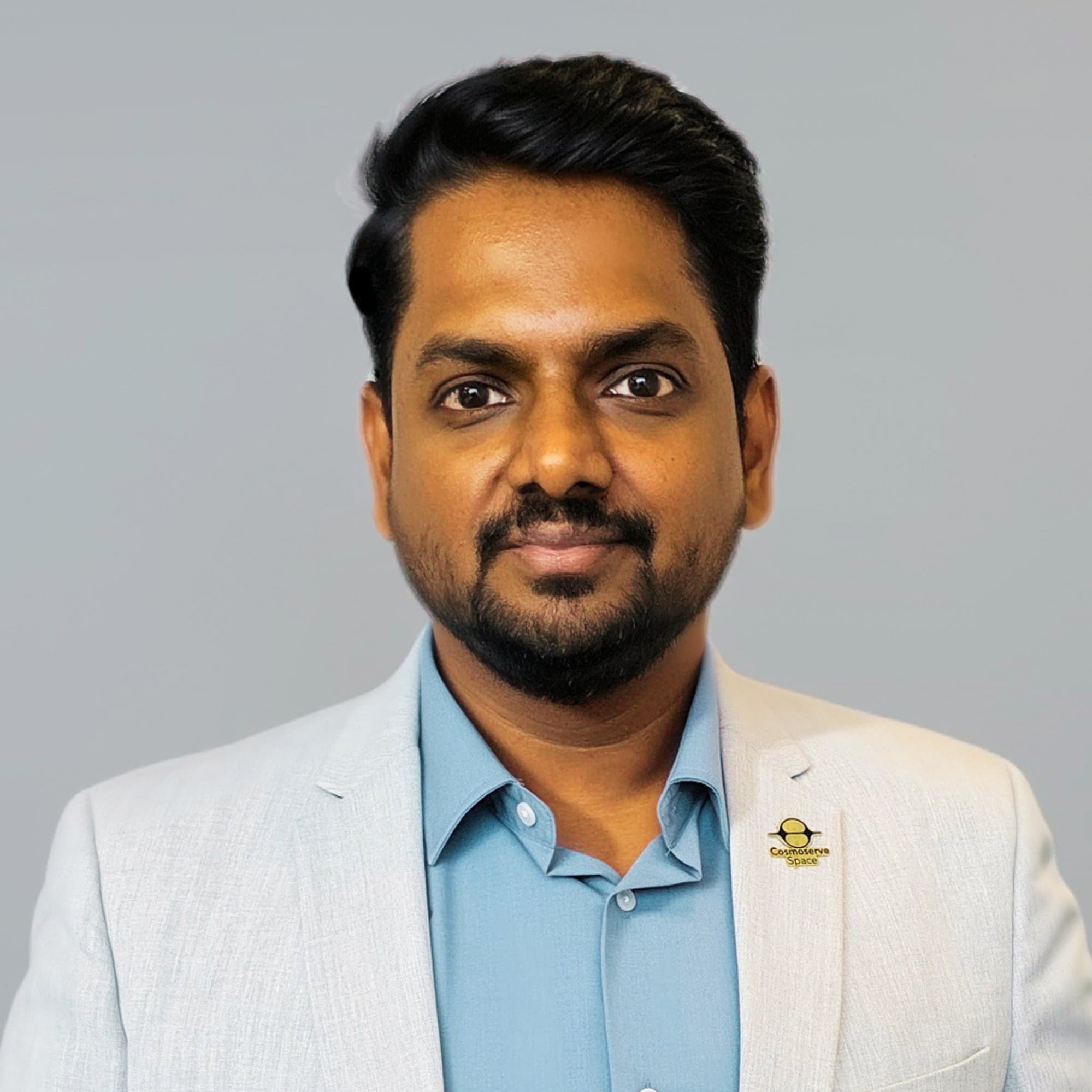
Chiranjeevi Phanindra B
Founder & CEO · Cosmoserve Space
Hyderabad/India
When humanity first reached space, imagination was fixed on escape: breaking gravity, crossing atmosphere, placing machines above Earth and proving that orbit could be reached. The question of what would happen to everything left behind came much later.
Decades of launches have filled orbit with dead satellites, spent rocket stages and fragments from old collisions. Many keep moving at speeds where even a small piece of metal can damage a spacecraft. The frontier that once symbolised human ambition is now becoming a working environment crowded with consequences.
A different kind of space founder is emerging from that shift. The challenge is quieter than launch, but deeply consequential: keeping orbit usable after governments, companies and constellations have begun to depend on it.
Chiranjeevi Phanindra belongs to that category of builders. After fourteen years inside ISRO, where he worked on thermal protection, re-entry systems, human spaceflight and debris protection, he left a Deputy Project Director role to build Cosmoserve Space. His company is focused on one of the hardest problems in the next space economy: capturing and removing objects already in orbit, including those that were never designed to be caught.
At ISRO, Chiranjeevi helped vehicles survive the harsh conditions of space. At Cosmoserve, he is asking a larger question: can orbit itself be protected before the next wave of satellites makes the problem harder to contain?
“We have learned to live with the problem. We are learning how to manage it. But solving it means going beyond the symptoms and removing the larger obstacles causing it.”
The Seconds Before Proof
Chiranjeevi’s early training was in systems where failure could rarely be corrected after the fact. Space engineering deals with conditions that punish weak assumptions: heat, pressure, vibration, velocity and separation events.
After completing his master’s in aerospace engineering from IIT Kanpur, he joined ISRO’s Vikram Sarabhai Space Centre in Thiruvananthapuram. He worked on aerothermal aspects of rockets, including thermal protection systems for launch vehicles and re-entry capsules.
Roughly eighteen months into the role, his supervisor asked him to lead a major test involving a nozzle closure system. The system had to prevent plumes from firing nozzles from contaminating inactive ones, hold under high-velocity impact and separate at exactly the right moment.
The first test failed. The team learned quickly, corrected the system and made it successful. Then came flight.
The vehicle configuration was flying to space for the first time. At around 115 seconds, the nozzle closure system had to separate cleanly.
“From around 80 or 90 seconds, my heart rate kept climbing. At 115 seconds, when the nozzle closure opened and we confirmed the thrusters had fired, there was an overwhelming sense of relief. It was more than happiness. It was relief.”
Relief is a revealing word in high-consequence engineering. It belongs to people who know how many assumptions have to hold together before success can be declared. Celebration comes later. First comes confirmation.
Space engineering teaches a particular kind of patience: the ability to live through the seconds before proof arrives. That emotional discipline now follows Chiranjeevi into entrepreneurship. Cosmoserve is a startup, but its problem belongs to a domain where speed without proof can create permanent consequences.
From Protection To Prevention
In 2019, ISRO began building its human spaceflight vertical. Chiranjeevi was among twenty-five people handpicked across centres to help start the programme. He moved to Bengaluru and joined the founding team working on systems India had to build from scratch.
Human spaceflight changed the nature of risk. Rockets and satellites already demand precision, but a crewed mission carries a deeper moral and engineering weight. The system must create an Earth-like environment inside a crew module. It must also protect astronauts from micrometeoroids and orbital debris.
Debris protection gave Chiranjeevi a close view of the problem. Objects larger than ten centimetres can be tracked. If one approaches a crew module or satellite, the operator can perform a collision avoidance manoeuvre. Smaller debris is harder. A one-millimetre aluminium particle moving at around 7.5 kilometres per second, roughly 28,000 kilometres per hour, can cause catastrophic damage.
For smaller particles, shielding remains essential. For larger tracked objects, manoeuvres remain necessary. The larger risk sits upstream. When bigger dead objects collide, they create smaller fragments, including pieces that become difficult or impossible to track. Removing large objects reduces the chance of future fragmentation.
“Solving the problem means addressing the larger objects first. The smaller ones are difficult to track and remove. When larger objects collide, they create smaller fragments, so preventing those collisions is key to solving the problem.”
Many organisations become skilled at coping with risk because coping is easier to fund, explain and operationalise. Prevention often appears too early for the market and too costly for the current budget. Yet coping becomes more expensive when the source of risk keeps multiplying.
Chiranjeevi’s founder thesis begins with that distinction. Cosmoserve is built around the belief that the future space economy will need companies that reduce orbital risk at the source. That belief sits at the heart of what may become the next defining logic of space: the maintenance premium.
As orbit becomes commercial infrastructure, value will move toward the companies that can keep orbital assets usable, safe and productive after launch.
What The Coordination Room Revealed
Through the Inter-Agency Space Debris Coordination Committee, Chiranjeevi saw how space agencies discussed the issue collectively. The committee brings together thirteen space agencies to debate and coordinate on debris mitigation. For a founder, that vantage matters because it shows where institutional agreement ends and the technology gap begins.
“We debate a lot in these meetings. There are strong disagreements and different perspectives, but eventually, we have to reach a common ground and agree on a way forward.”
The sentence carries the discipline of multilateral work. Agencies have to debate, converge and move. Coordination can shape norms, influence regulation and improve responsibility, but the physical problem still requires hardware, capture systems, mission design and repeatable execution.
For Chiranjeevi, the committee experience revealed two signals at once: the debris problem was going to become much larger, and the technology available to address it was still far from matching the scale of the challenge.
Over seven decades, humanity launched roughly 20,000 objects into space. Chiranjeevi points to a very different coming decade, with close to one million satellites expected to be launched. Around 50,000 tracked objects above ten centimetres already exist in orbit. About 13,000 are operational satellites. The remaining population consists largely of dead satellites and fragments.
The demand signal has begun to sharpen through regulation. Chiranjeevi points to the US Federal Communications Commission’s five-year rule, which requires satellite operators using the US market to bring down dead satellites within five years of end of life. The rule has begun turning end-of-life disposal into a compliance issue.
The best companies build the technology before the demand emerges. But you need strong conviction that the demand will eventually come.
Conviction, in this context, is disciplined reading. The founder, team, investors and early supporters have to believe before the market becomes obvious because deep-tech companies often spend years building before commercial proof arrives.
Catching The Unprepared
Much of the existing orbital population was never designed for removal.
A dead satellite may be tumbling. A fragment may be irregular. A spent object may carry no docking plate, no adaptor and no cooperative interface. Future satellites can be designed with removal in mind. Older debris carries the full difficulty of the past.
Cosmoserve’s technical bet begins there.
The company is building a capture mechanism inspired by the Venus flytrap. It uses four soft robotic petals, independently controlled and highly flexible, to close around objects in space. Chiranjeevi describes the system as having almost infinite degrees of freedom. The aim is to capture unprepared targets across different shapes and sizes, roughly from ten centimetres to two metres, without damaging them.
“When we began thinking about how to capture objects in space, we developed the idea of flexible, soft robotic petals. There are four independently controlled petals, each with an extraordinary range of movement. They can adapt to the shape of an object, move around it and securely capture it.”
Several global approaches assume a more cooperative target. Chiranjeevi notes that Astroscale uses a magnetic docking plate for prepared customer satellites. ClearSpace uses a different capture approach, with limitations around shape, size and degrees of freedom. Cosmoserve is attempting to work on objects already in orbit, moving without any intention of being caught.
Serious differentiation often begins with the reality a company chooses to solve.
Startup Speed With Mission Discipline
Startups can move faster because their teams are smaller, decisions take less time, procurement can be quicker and procedural delays can be reduced. Chiranjeevi accepts those advantages, while drawing a hard boundary around engineering discipline.
Even in a startup, we need to follow that discipline. We need to follow that testing.
Procedure can be shortened. Process has to remain intact.
In a high-consequence domain, that line matters. A company can accelerate decision-making without weakening validation. It can buy faster without testing less. It can operate with a leaner team without lowering the standard of proof.
Chiranjeevi’s inherited method is stress testing. He describes it in plain language.
“We abuse the hardware on ground.”
The purpose is to test until the system fails, because failure on the ground reveals what flight may punish later. Design flaws, material weaknesses and hardware limits have to surface before the mission enters an environment where correction becomes costly, slow or impossible.
Cosmoserve’s roadmap depends on that discipline. A version of its capture mechanism has flown through Mission Embrace on Vikram-1. A second version is planned. A larger demonstration, involving the full sequence of sending a satellite to space, capturing a target and removing it from orbit, is planned for the next phase. Commercial operations are targeted around 2028.
The Founder’s Pressure Point
The hardest part of Cosmoserve’s path is timing. Chiranjeevi’s ISRO training gives the company its discipline, but that same discipline carries a cost in time. Debris removal has to be proven slowly enough to be trusted, while the commercial market is beginning to move.
That tension is sharper because global competitors are already active. Astroscale has demonstrated capability and won contracts. ClearSpace has helped bring attention to the category. Regulation is beginning to push satellite operators toward end-of-life responsibility. Cosmoserve is building toward larger demonstrations and commercial operations in a window where the market is forming, but attention is already being claimed.
For Chiranjeevi, the bet is that trust built through mission-grade rigour can compete with first-mover momentum. Move too slowly and the market may consolidate around others. Move too quickly and the company risks weakening the discipline that makes its technology credible.
The pressure point remains open. Cosmoserve has to prove the mechanism, prove the mission, prove repeatability and then convince buyers that removal has moved from responsibility to necessity. In deep technology, motivation starts the company; endurance decides whether the company reaches the market it saw early.
The Cost Of A Harder Problem
Chiranjeevi left ISRO after reaching Deputy Project Director on India’s human spaceflight mission. He names one regret plainly.
“One regret I have is that I could not see through the human spaceflight mission while I was serving as Deputy Project Director. But the urge to start something of my own and solve this problem was so strong that I could not hold myself back.”
The regret gives the story its human weight. He stepped away from a national mission he had helped build, before seeing it through from the position he had earned.
Founders often speak of sacrifice through the language of risk: salary, security, comfort, time. Chiranjeevi’s sacrifice had another dimension. He gave up the chance to complete a major institutional chapter from inside the institution.
The motivational force in his story comes from that trade-off. It is the seriousness of carrying a problem strongly enough to leave something meaningful behind.
Entrepreneurship is not always an escape from structure. In deep technology, the best founders often carry structure with them. Chiranjeevi left ISRO, but the habits of testing, systems thinking and engineering accountability travelled with him.
The institution gave him discipline. The startup gives him speed. His work now depends on making both coexist.
India’s Opportunity After Launch
India’s space story has often been told through launch capability and cost efficiency. Chiranjeevi respects that legacy, but his reading of the next opportunity is more specific.
He believes the future lies in ISAM: in-orbit servicing, assembly and manufacturing. Debris removal is one part of that larger layer. Refuelling satellites, attaching propulsion systems, repairing electronics, replacing components and eventually building structures in orbit all belong to the next space economy.
Once you have commercialised your technology and built on the resources available to you, the next challenge is sustaining it. Without that focus on maintenance, you cannot continue your commercial operations or scale them effectively.
The argument reframes India’s opportunity. The country can define its future through the infrastructure layer that keeps orbital assets productive after launch. Launch built credibility. Maintenance can build long-term economic relevance.
Leadership Lessons
Risk has to be understood at the source. Shielding protects missions from debris, while removal reduces the future creation of smaller untrackable fragments.
Conviction before demand requires evidence. Chiranjeevi built Cosmoserve because orbital density, agency discussions, regulation and technology gaps pointed in the same direction.
Speed is useful only when proof remains intact. Startups can shorten decisions, procurement and coordination. High-consequence domains still demand the full discipline of validation.
Testing has to reveal the breaking point. Systems tested only until they function can carry hidden weakness. Stress testing to failure creates the knowledge required for reliability.
A founder’s strongest advantage may be the problem he has lived with deeply. Chiranjeevi’s insight came from thermal protection, human spaceflight systems, debris shielding and global debris coordination before it became a company.
Differentiation begins with the reality a company chooses to solve. Cosmoserve is designing for unprepared and tumbling objects because much of the existing orbital problem sits there.
Deep-tech founders need shared conviction. A long validation cycle cannot rest only on the founder’s belief. Teams, investors and partners have to understand the time horizon before the market becomes obvious.
Institutional discipline can travel into entrepreneurship. Chiranjeevi’s move from ISRO to Cosmoserve is powerful because the discipline of testing, systems thinking and accountability continues inside a startup environment.
The Founder Building For The Harder Orbit
Chiranjeevi’s work asks the space economy to take responsibility for its own success. The more orbit is used, the more maintenance becomes central to growth.
His story is motivational because it is grounded in difficulty. He left a national mission with regret, saw a problem before the market fully accepted it, chose a category where proof takes years and built for a version of reality that is harder than prepared satellites and clean docking assumptions.
Cosmoserve is a debris-removal company, but the larger bet is on the maintenance layer of the space economy. As satellites become infrastructure, the companies trusted to preserve orbital continuity will become as important as the companies that place assets there.
If Chiranjeevi is right, the next premium in space will belong to those trusted to maintain orbit after everyone has learned how to use it.
Our Suggestions to Read
Discover The Leaders Shaping India's Business Landscape.
Corporate Visionaries
Shashank Sahni on What Success Leaves Out
Shashank Sahni, Google’s Managing Director of Global Ads Solutions, reflects on what customers reveal, what ambitious teams need from their leaders & what the mountains and marathons have taught him about going further.
Read Full Story
Corporate Visionaries
Clinical Multiplication: Divesh Singla on the Healthcare AI Case That Headlines Keep Missing
Divesh Singla, Managing Director, India at Veradigm, brings two decades in healthcare technology to the AI question leaders cannot avoid: how to expand clinical capacity without weakening human judgment.
Read Full Story
Investors & Catalysts
The Physical Economy Was Never Slow: A Conversation with Nikhil Choudhary
Nikhil Choudhary, Managing Partner at Nirman Ventures, on the harder ground of technology, where physical AI, venture discipline and industrial adoption have to meet the realities of machines, workers, capital and trust.
Read Full Story