Intelligence
Beyond the 7.8% Headline: What the “Dead Economy” Remark Missed
When confidence in India’s post-Covid recovery was fragile, the then Chief Economic Adviser saw a 7% growth decade ahead. 5 years later, the latest 7.8% Q1 GDP print gives that call sharper context.
I
August 31, 20265 min read
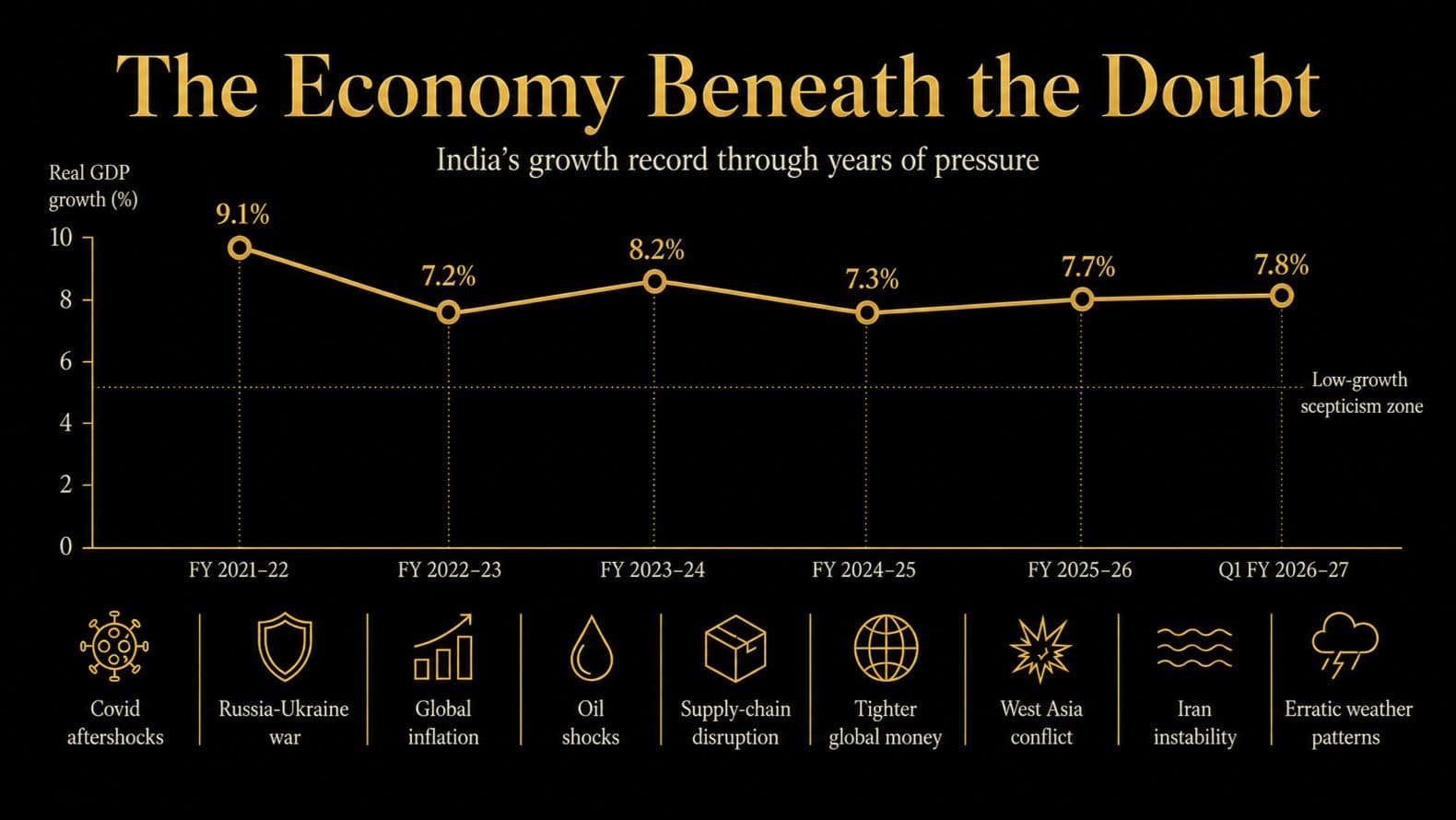
For five years, the world kept finding reasons why India’s growth story should weaken. The economy kept finding reasons why it did not.
Real GDP grew 7.8% in Q1 FY 2026-27, ahead of expectations and against a global environment that offered little comfort. Since 2021, India has moved through Covid aftershocks, the Russia-Ukraine war, global inflation, oil shocks, tariff tensions, supply-chain disruption, tighter global money, conflict in West Asia, renewed instability around Iran and increasingly erratic weather patterns.
Through that period, India repeatedly faced one question: would growth survive once the immediate post-pandemic rebound faded?
In September 2021, when India was still recovering from one of the sharpest economic shocks in its modern history, Prof. Krishnamurthy V. Subramanian, then Chief Economic Adviser to the Government of India, made a clear longer-term call.
“On average, I expect growth to be greater than 7 per cent in this decade for India.”
The mood then was still shaped by damage. A rebound was visible, but confidence in its durability was limited. Many saw the contraction. Prof. Krishnamurthy was reading the capacity underneath it.
His argument rested on the V-shaped recovery, quarterly growth patterns, supply-side reforms, easing of regulations, infrastructure investment, manufacturing incentives, credit revival, vaccination-led normalisation and the multiplier effect of public capital expenditure. The central claim was simple: India’s productive engine had been interrupted, not broken.
The policy context around that period also matters. In February 2021, while presenting India’s first digital Union Budget, Finance Minister Nirmala Sitharaman described the post-Covid world as “the dawn of a new era”, positioning India as a land of promise in a changing global order.
Prime Minister Narendra Modi’s post-pandemic framing carried a similar economic direction through AatmaNirbhar Bharat: turning crisis into opportunity, reducing excessive dependence on critical imports, scaling domestic production and using technology as a lever of transformation.
Seen together, the economic direction of 2021 was built around domestic capacity, infrastructure, manufacturing, credit, capital expenditure and reform-led supply-side expansion. Prof. Krishnamurthy’s growth call belonged to that broader policy direction.
Five years later, the record gives that reading a stronger base.
The growth sequence he pointed to is difficult to ignore: 9.1% in FY 2021-22, 7.2% in FY 2022-23, 8.2% in FY 2023-24, 7.3% in FY 2024-25, 7.7% in FY 2025-26, and now 7.8% in Q1 FY 2026-27. GDP estimates can move with revisions and base-year changes, but the broader pattern remains clear: the post-Covid rebound did not fade. India continued to grow through repeated global shocks.
The latest official data adds depth to the headline. Real GDP grew 7.8%, nominal GDP grew 10.3%, and real GVA grew 8.2% in Q1 FY 2026-27. Manufacturing expanded 9.2%, the tertiary sector grew 10%, and financial, real estate, IT and professional services advanced 12.1%. Gross fixed capital formation grew 11.9%, compared with 5.8% in the same quarter a year earlier.
The investment number deserves particular attention. Consumption reflects current demand. Investment reflects preparation for future demand. When capital formation strengthens alongside manufacturing and services, growth begins to look less like a rebound and more like capacity creation.
The economy also looks broader than many critics assumed. GST collections, vehicle sales, manufacturing PMI, foreign-exchange reserves and equity-market levels measure different parts of the system. Used crudely, they become a scoreboard. Read carefully, they show formalisation, domestic demand, industrial sentiment, external buffers and financial-market depth moving through the same period of uncertainty.
The strongest answer to doubt has come through work.
Factories produced. Entrepreneurs invested. Workers showed up. Households consumed. Taxpayers moved deeper into the formal economy. Policymakers pushed capital expenditure, infrastructure and manufacturing incentives. Public institutions managed stability while the global environment became harder to read.
Growth at this scale is built across the economy: in factories, farms, offices, ports, banks, homes, startups, MSMEs, public projects and private balance sheets. It comes from people making decisions every day before the final number ever appears in a data release.
Economic criticism remains necessary. India still has hard questions on employment quality, household incomes, export competitiveness, private-investment durability, energy dependence, productivity and wider prosperity. A strong GDP number cannot settle those questions. It raises the level at which they must now be asked.
Serious criticism, however, must respond to evidence. For years, India’s growth was expected to fade for one reason after another: base effects, reopening limits, inflation, oil, global rates, weak demand, supply chains and geopolitical shocks. Many concerns were valid. The economy kept absorbing them.
The burden of explanation has shifted.
Those who saw only temporary momentum now have to explain persistence. Those who saw only fragility now have to explain resilience. Those who dismissed India’s economic capacity now have to account for a growth record built across five difficult years.
Prof. Krishnamurthy’s 2021 call deserves attention for precisely that reason. It came from a deeper reading of India’s productive capacity at a time when the visible narrative was still dominated by crisis. The subsequent record has made that reading harder to dismiss.
India’s next phase will be more demanding. Sustaining high growth from a larger base will require deeper manufacturing, stronger private capital formation, better jobs, higher productivity, more competitive exports and faster transmission of growth into household prosperity.
Five years ago, the central question was whether India could recover from a historic shock. Today, the sharper question is what kind of economic capacity India has built since then.
Calling India a “dead economy” was always too crude for a country of this scale and complexity. The latest GDP print makes the description look even smaller. India’s record over the last five years has not settled every economic question, but it has settled one: the economy has been far more resilient than its harshest critics were willing to admit.
Those who kept waiting for the growth story to fade now have the harder task of explaining why, through shock after shock, it kept compounding.
More Intelligence

Can Sugar-Free Chocolate Become the Next Billion-Dollar Better-for-You Food Category?
Sugar-free chocolate, already a USD 2.6 billion global market, is projected to reach USD 4.86 billion by 2034, as better-for-you indulgence moves from niche demand toward mainstream consumption.
August 18, 2026
Industrial Cybersecurity Market: India’s Role In A USD 54.8 Billion Global Cyber-Resilience Opportunity
As factories, utilities & supply chains connect faster, India is emerging as a force in the USD 54.8 billion industrial cybersecurity market, where resilience will define the next industrial edge.
August 6, 2026

Digital Transformation on the Shop Floor: Why the Industrial AR Glasses Market Is Gaining Momentum
Industrial AR glasses are becoming the operating interface of connected factories, linking workers and expertise as the market is projected to grow from $4.2 billion in 2025 to $19.8 billion by 2034.
July 23, 2026