Intelligence
Can Sugar-Free Chocolate Become the Next Billion-Dollar Better-for-You Food Category?
Sugar-free chocolate, already a USD 2.6 billion global market, is projected to reach USD 4.86 billion by 2034, as better-for-you indulgence moves from niche demand toward mainstream consumption.
A
Ashish Kolte (Dataintelo)
August 18, 202611 min read
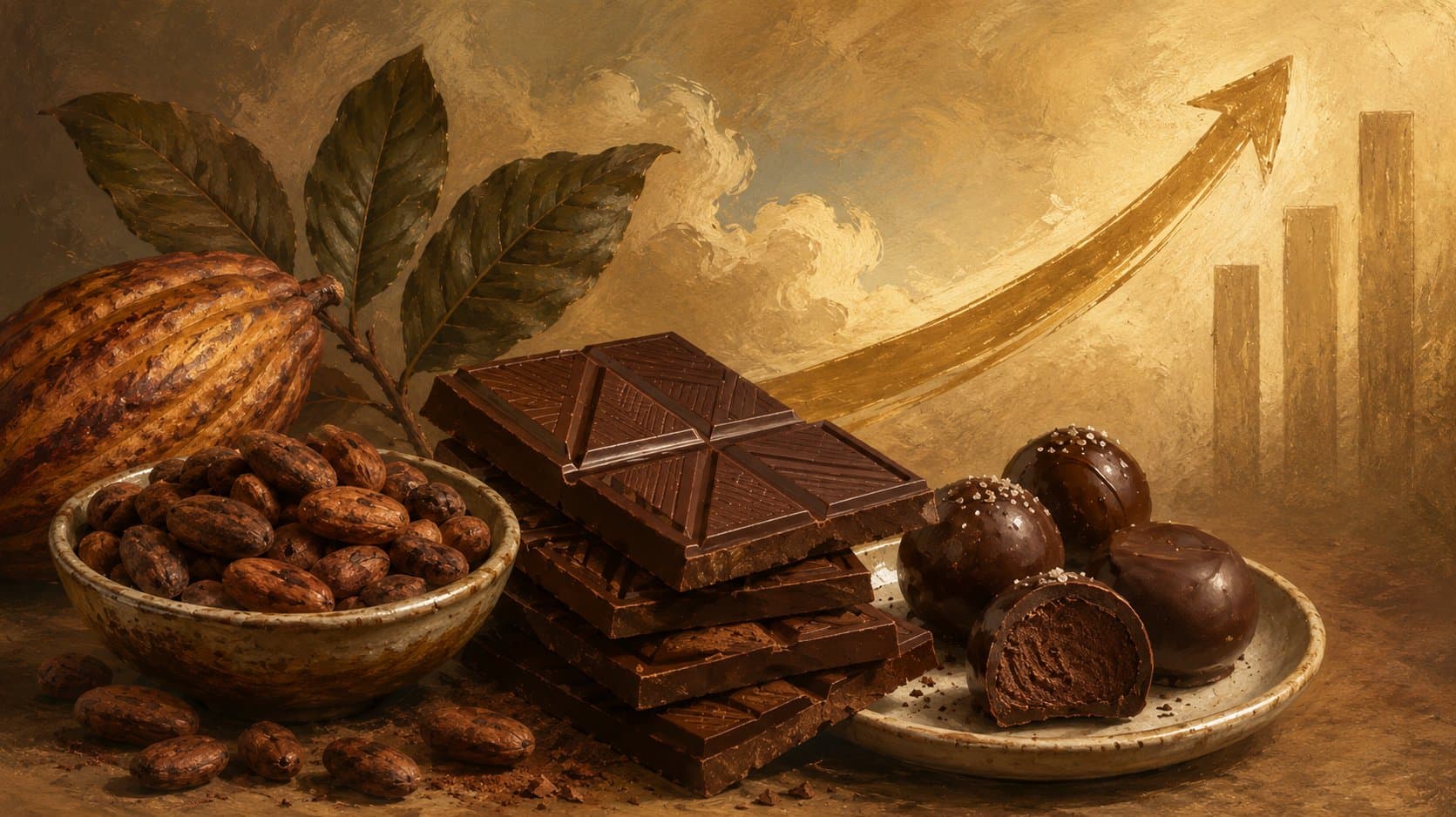
A sugar-free chocolate bar once carried an implicit explanation. The person buying it was probably managing diabetes, counting calories or following a tightly controlled diet. Today, the same product can land in the basket of a thirty-year-old professional trying to reduce added sugar, a parent making a more considered snack choice, or someone who simply expects indulgence to fit more comfortably into a health-conscious lifestyle.
That change in who is buying may prove more consequential than another round of product launches.
Sugar-free candy and chocolate already represent an estimated ₹24,440 crore (USD 2.6 billion) global market, with projections taking the category toward ₹45,684 crore (USD 4.86 billion) by 2034. The adjacent low-sugar chocolate market is larger still, estimated at approximately ₹39,480 crore (USD 4.2 billion) in 2025 and projected to reach about ₹74,260 crore (USD 7.9 billion) by 2034. Both are expanding faster than the broader chocolate market, which suggests that consumer spending inside confectionery is gradually shifting toward products promising a different balance between pleasure and health.
The difficult part is that consumers are changing their relationship with sugar much faster than they are changing their expectations of chocolate.
They may accept fewer calories, less sugar or a different ingredient list. They are far less willing to accept weaker taste, poorer texture or a product that feels like a compromise.
That tension is turning sugar-free confectionery into a useful case study in how better-for-you food categories actually become mainstream.
When a Dietary Product Starts Becoming a Consumer Category
For years, sugar-free confectionery was defined largely by restriction. Products were designed around what consumers needed to avoid rather than what they actively desired.
The category is now being pulled into a broader change in food consumption. Consumers are paying more attention to added sugar, carbohydrates, ingredient quality and metabolic health without necessarily identifying themselves as dieters. Keto and low-carb lifestyles have expanded the audience further, while premium shoppers increasingly treat health, sustainability and ingredient transparency as part of the value equation rather than as specialist requirements.
That distinction matters because it changes the commercial proposition.
A product bought because someone cannot eat conventional chocolate behaves differently from a product chosen because someone prefers it. The first can survive on functionality. The second has to compete on taste, brand, packaging, experience and price with every other chocolate on the shelf.
The adjacent vegan chocolate market illustrates how quickly that transition can happen. The category was valued at around USD 1.4 billion in 2025 and is projected to double to roughly USD 2.8 billion by 2034, supported by health, plant-based consumption, ethical sourcing and premium positioning.
Sugar-free chocolate appears to be moving through a similar transition: from specialist alternative to a broader better-for-you proposition.
The companies that understand that shift early will probably build very different businesses from those treating sugar reduction simply as another SKU extension.
What Hershey Saw in Lily's
The contrast between Lily's Sweets and some of the industry's unsuccessful reformulation attempts offers one of the clearest clues.
Lily's was built from the beginning around reduced-sugar chocolate and alternative sweeteners. By the time Hershey acquired the company in 2021 for approximately ₹3,995 crore (USD 425 million), Lily's had already established meaningful traction among consumers actively looking for lower-sugar confectionery.
Cadbury approached the challenge differently.
Its 30% Less Sugar Dairy Milk, introduced in 2019, carried the power of one of chocolate's most recognisable brands but struggled to build lasting demand and was eventually withdrawn. Nestlé's Wowsome reduced-sugar chocolate met a similar fate.
The difference is more revealing than a simple success-versus-failure comparison.
Consumers approaching Dairy Milk already know what Dairy Milk should taste like. The expected sweetness, creaminess and texture have been reinforced over years, sometimes decades. A reformulated version is therefore competing not only against other chocolate bars but against the consumer's memory of the original.
Lily's started with a different contract. Lower sugar was part of the proposition from the beginning, so consumers did not experience the product as a modified version of something they already loved.
That turns sugar reduction into a question of brand architecture.
Should a major confectionery company alter its flagship product gradually? Build a separate health-oriented line? Launch a new brand with different expectations? Or acquire a company that already understands the emerging consumer?
Hershey's decision suggests that, in some cases, acquiring category credibility can be more efficient than asking a heritage brand to stretch into unfamiliar territory.
For founders, there is an equally important lesson. Large incumbents can replicate manufacturing and distribution far more easily than they can immediately reproduce trust with a consumer cohort that a challenger has spent years understanding.
The Product Still Has to Taste Like Chocolate
Better branding cannot solve an inferior product.
Sugar does considerably more inside chocolate than make it sweet. In some formulations it can represent roughly 40% to 50% of finished product weight, contributing bulk and influencing texture, viscosity, particle distribution and mouthfeel.
That explains why sugar reduction has historically produced trade-offs.
High-intensity sweeteners such as stevia can provide sweetness without equivalent bulk. Sugar alcohols such as maltitol, erythritol and xylitol restore some physical characteristics but bring different sensory and digestive considerations. Fibres and bulking agents can help rebuild texture, yet the finished product still has to melt, snap and taste like something consumers willingly buy again.
The category has improved considerably because manufacturers increasingly combine sweeteners and formulation techniques instead of expecting one ingredient to replicate sugar perfectly.
Dark chocolate has been the natural beneficiary. One market analysis estimates that it accounts for almost 49% of sugar-free chocolate, helped by stronger cocoa flavour and naturally lower sweetness expectations.
The underlying business lesson is simple but often underestimated: health can create trial; taste creates recurrence.
That distinction explains why better-for-you food can generate enormous launch activity while producing relatively few durable brands. The category winner is not the company making the strongest health claim. It is the company that makes consumers stop thinking about the compromise.
What Happens When Consumers Start Reading the Rest of the Label?
Sugar-free once functioned as a powerful claim almost by itself.
That advantage is becoming harder to sustain.
Consumers reducing sugar are increasingly interested in what replaced it. Artificial sweeteners have carried shifting perceptions for decades. Sugar alcohols can create digestive discomfort for some consumers at higher intake levels, while newer scientific discussions around ingredients such as erythritol and xylitol have added another layer of scrutiny.
That does not automatically make these ingredients unsuitable, but it changes the competitive environment.
A company can spend years building a formulation around one sweetener only to discover that consumer preference has migrated toward another. Today's clean-label hero can become tomorrow's ingredient consumers Google before purchasing.
The implication is that the better-for-you category will probably evolve beyond "zero sugar" as its dominant language.
Ingredient familiarity, glycaemic response, digestive tolerance, calorie profile and transparency will increasingly shape purchasing alongside the sugar number itself.
For brands, flexibility therefore matters almost as much as formulation quality. The ability to adapt while preserving taste could prove more valuable than dependence on any one fashionable replacement ingredient.
Growing Faster Does Not Mean Earning More
The category's economics carry another contradiction.
Health-conscious products often lean toward higher cocoa content and more premium ingredients, while cocoa itself has experienced extraordinary price volatility. During the recent supply shock, prices moved from around USD 2,400 per tonne to above USD 11,000 per tonne at the most extreme point reflected in the underlying research.
At the same time, alternative sweeteners, specialised ingredients and smaller production runs can make sugar-free formulations more expensive than conventional chocolate.
Consumers have demonstrated some willingness to absorb that difference. The research indicates that sugar-free and low-sugar products can command premiums of roughly 15% to 30%, with some premium segments stretching further.
Yet premium pricing is not infinite.
The category therefore contains an important lesson for investors: a fast-growing market can still produce difficult unit economics.
Companies must manage ingredient costs, sourcing, manufacturing efficiency, pack sizes and pricing while preserving enough sensory quality to generate repeat purchase. A business built on expensive acquisition and weak recurrence can grow revenue quickly while creating little durable value.
The better opportunity may sit where product differentiation and economics reinforce each other.
How Smaller Brands Found a Route Around the Shelf
Traditional confectionery has always rewarded scale.
Major manufacturers possess retailer relationships, distribution networks, manufacturing capacity and the promotional budgets required to win high-traffic shelf space. That made specialist products difficult to scale when demand was dispersed.
Digital commerce has changed the equation.
Online sugar-free confectionery is estimated to be growing at approximately 14.2% annually, more than twice the growth rate of the overall category.
For emerging brands, the advantage goes beyond distribution.
A consumer buying conventional chocolate needs little education. Someone evaluating sugar-free chocolate may want to understand the sweetener, carbohydrate profile, ingredients, dietary compatibility or why the product carries a premium. Digital channels give brands enough room to tell that story, collect first-party data and build repeat purchasing before attempting national retail expansion.
That is particularly important in categories where consumers are still learning how to evaluate products.
A small brand no longer needs millions of mainstream buyers on day one. It needs a sufficiently concentrated group that cares deeply about the problem it solves.
The resulting consumer intimacy can become strategically valuable. By the time an incumbent decides the segment is large enough to pursue aggressively, the challenger may already know which flavours repeat, which claims convert, how much consumers will pay and what causes them to leave.
That knowledge is harder to purchase than shelf space.
India Is Still Early, Which Is Precisely the Point
Asia Pacific is among the fastest-growing regions for sugar-free and low-sugar chocolate, with growth estimates around 9% annually across the supplied market research. India sits within that expansion from a comparatively small base.
The Indian sugar-free chocolate market is estimated at roughly ₹1,000 crore (USD 106 million), modest relative to the country's population and overall confectionery consumption.
That should be read as whitespace rather than weakness.
India combines a large and increasingly health-conscious urban consumer population with rising diabetes awareness, rapidly expanding e-commerce and an established appetite for premium chocolate. The broader Asia-Pacific market is also demonstrating that better-for-you chocolate does not need to remain a Western phenomenon.
The opportunity for brands will be to avoid treating India merely as another geography for imported formulations.
Taste preferences, pricing thresholds, pack sizes, gifting occasions and distribution economics differ materially. Premium urban consumers may accept a substantial price differential for a genuinely differentiated product, while mass-market expansion will require much tighter cost discipline.
The category therefore offers room for both international players and Indian challengers, particularly businesses that understand health-conscious consumers without positioning the product as medicine.
That distinction may determine whether sugar-free chocolate remains confined to specialist shelves or begins competing for mainstream indulgence occasions.
Where Founders and Investors Should Look
The obvious opportunity is to launch another sugar-free chocolate brand.
The more interesting opportunities may sit around the problems every such brand eventually encounters.
One value pool lies in consumer brands capable of building strong taste credentials, repeat purchase and a proposition that extends beyond dietary restriction. Lily's demonstrated how strategically valuable that position can become when a challenger earns consumer permission before larger companies fully commit.
A second sits in ingredients and formulation. Companies capable of improving taste, mouthfeel or sweetener performance can potentially serve multiple brands and categories rather than relying on one consumer proposition.
A third sits in specialised manufacturing. As formulations become more complex, younger brands may possess consumer understanding but lack the production capability required to make products consistently at commercial scale.
Functional confectionery creates another opportunity as chocolate increasingly overlaps with protein, fibre and other wellness-oriented ingredients. The broader chocolate market already identifies functional formats as one of the faster-growing innovation areas.
For investors, the important distinction is between growth and scarcity.
A category can support dozens of brands. The more durable economics may accumulate around whichever capability remains difficult to reproduce after the market becomes crowded.
That could be a consumer brand with exceptional loyalty.
It could be proprietary formulation.
It could be manufacturing expertise.
Or it could be a company with such deep understanding of health-conscious confectionery consumers that a global incumbent eventually decides buying the capability is faster than building it.
The Lily's transaction is useful precisely because it demonstrates that category-native businesses can become strategically valuable before they become global giants.
The First Bite Still Decides the Category
Sugar-free chocolate has many of the characteristics investors look for in an emerging consumer category: a multi-billion-dollar market, growth faster than conventional chocolate, strong health tailwinds, improving technology and a consumer base expanding beyond people with explicit dietary restrictions.
None of those factors guarantees mainstream adoption.
Consumers may increasingly want less sugar, but they still approach chocolate for pleasure. The moment a better-for-you proposition makes indulgence feel like a sacrifice, the category loses the very advantage it is trying to preserve.
That is why the strongest lesson from Lily's, Cadbury and the wider market has relatively little to do with sugar itself.
Successful brands will have to make health-conscious chocolate desirable on its own terms, not merely acceptable as an alternative. Established manufacturers will need to decide carefully which brands can stretch and where new propositions are required. Founders will need to solve for repeat purchase rather than launch curiosity. Investors will need to distinguish between a growing market and businesses that have built something genuinely difficult to copy.
Sugar-free chocolate may well become one of the next major better-for-you food categories.
The companies that matter most will be those that eventually make consumers stop thinking of it as the sugar-free option at all.
Contributor Note
This article has been contributed by Dataintelo and authored by Ashish Kolte, Marketing Manager at Dateintelo.
About Dataintelo
Dataintelo is a market research and business consulting firm specialising in industry intelligence, market sizing, trend analysis, opportunity assessment and forecasting. The company supports global enterprises and small and medium-sized businesses through syndicated research, customised studies, consulting services and regularly updated market databases.
More Intelligence
Beyond the 7.8% Headline: What the “Dead Economy” Remark Missed
When confidence in India’s post-Covid recovery was fragile, the then Chief Economic Adviser saw a 7% growth decade ahead. 5 years later, the latest 7.8% Q1 GDP print gives that call sharper context.
August 31, 2026

Industrial Cybersecurity Market: India’s Role In A USD 54.8 Billion Global Cyber-Resilience Opportunity
As factories, utilities & supply chains connect faster, India is emerging as a force in the USD 54.8 billion industrial cybersecurity market, where resilience will define the next industrial edge.
August 6, 2026

Digital Transformation on the Shop Floor: Why the Industrial AR Glasses Market Is Gaining Momentum
Industrial AR glasses are becoming the operating interface of connected factories, linking workers and expertise as the market is projected to grow from $4.2 billion in 2025 to $19.8 billion by 2034.
July 23, 2026