Category: Founders & Innovators
Ankita Khandelwal blends the urgency of finance with the endurance of steel, turning a legacy business into a platform for reinvention rather than inheritance. Her leadership reframes resilience as redesign, technology as leverage, and steel as a strategic barometer of national strength. With ethics as structure and adaptation as discipline, she shows that real leadership like steel works quietly, strengthens everything around it, and endures far beyond visibility.
The Invisible Architectures of Leadership: Ankita Khandelwal on Resilience, Reinvention, and the Future of Steel
IndiSight Editorial
Sep 23, 2025
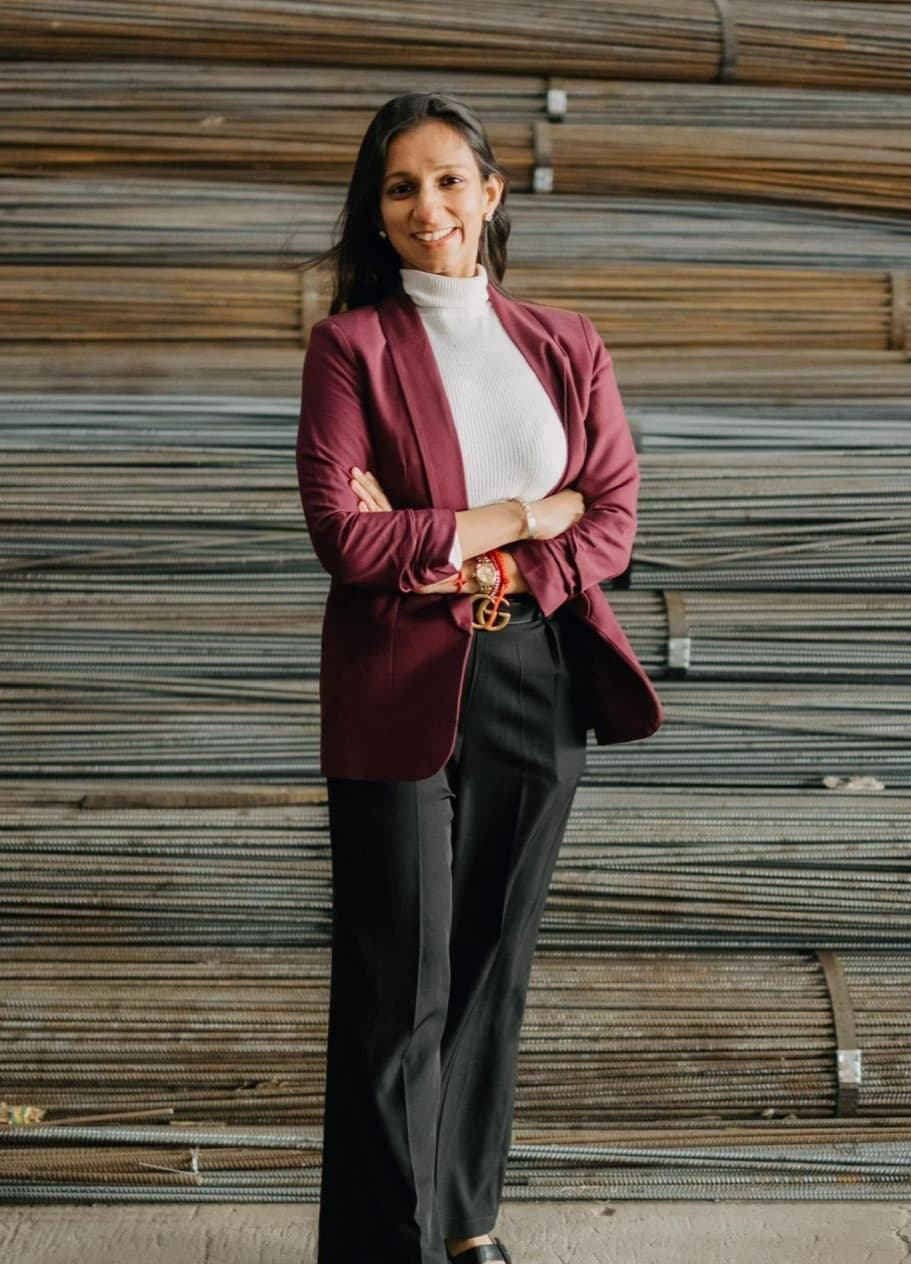
Ankita Khandelwal
Director · Delhi Trading Corporation
Jaipur
A Career of Opposites
When Ankita Khandelwal first appeared on CNBC as a young financial analyst in Mumbai, she was immersed in a world where fortunes shifted in hours, not years. Numbers moved quickly and so did her career. She wrote for business magazines, built a reputation for her ability to explain risk, and believed finance would be her long-term home.
Marriage took her to Jaipur, and with it came a new chapter. Her husband Aditya Khandelwal, along with his family, was leading DTC Group, a longstanding channel partner of Tata Steel. It was an industry Ankita had known only through balance sheets and quarterly reports. Walking into steel yards and listening to dealers talk about supply, wastage, and infrastructure was a different education altogether. What looked like a detour has become her central arena.
“Finance taught me speed. Steel taught me patience,” she reflects.
The juxtaposition between two worlds gave her more than career progression. It gave her a way of thinking. Fast markets shaped her instinct for urgency. Enduring materials taught her the value of systems that must last long after the excitement fades. Together, they built her intellectual compass.
Legacy and Reinvention
Every family business lives inside a paradox. Continuity protects, but continuity can also suffocate. Legacy builds trust, but it can also impose inertia.
“The culture and the core must remain intact. But growth demands reinvention,” Ankita says.
In DTC’s case, reinvention has meant pioneering downstream solutions in steel, a direction Ankita has driven in close partnership with her husband Aditya Khandelwal and the second generation of leadership at DTC. Prefabricated cut-and-bend rebars reduce waste, compress timelines, and inject efficiency into projects. On the surface this looks like an operational upgrade. In practice, it is a strategic shift: moving from selling commodities to solving problems in national infrastructure.
Her framework is clear:
Legacy is the anchor.
Innovation is the edge.
Leadership is the tension between the two.
This framing extends far beyond steel. Banks, schools, technology companies, even governments face the same challenge. Too much loyalty to legacy creates stagnation. Too much obsession with reinvention creates instability. The leader’s task is not to choose one, but to manage the contradiction without collapsing it into an easy answer.
Steel as National Barometer
If oil has long been the global barometer of power, Ankita argues that steel carries a similar weight for the century ahead. Consumption is a direct proxy for how nations grow, and growth defines how nations compete.
“Steel is the benchmark of development. If you want to know how a country is doing, measure its steel.”
China’s rise was inseparable from its steel capacity, which at its peak absorbed half the world’s output. Europe, unable to match scale, chose to invest heavily in sustainability, pioneering green steel technologies. The United States, after years of neglect, has rediscovered steel through its trillion-dollar infrastructure revival.
India must decide where to place its flag. Ankita believes the answer is balance. Scale without sustainability risks collapse. Sustainability without scale risks irrelevance. Balance gives India an advantage, but only if it avoids complacency.
“If there is one thing we must unlearn, it is dependency. Dependency on labor. Dependency on imports. Innovation must make us self-reliant.”
This is more than an industry view. It is a call to leaders across sectors to stop seeing their industries as markets alone. They are strategic infrastructures, shaping how nations position themselves in a competitive world.
Technology Without Abdication
Every sector is wrestling with the same question: how far can technology replace human judgment?
“AI should handle logistics and repetition. But the final authority must remain human.”
For Ankita, technology is neither savior nor threat. It is leverage. COVID-19 tested this conviction. When supply chains froze and projects stalled, DTC could have waited it out. Instead, Ankita and her team reimagined how steel could be bought and sold. Through Tata Aashiyana, they opened an online channel that allowed households to order steel with the same ease as consumer goods.
“No one believed steel could be sold online. After COVID, it became normal.”
The real transformation was not the technology but the psychology. For the first time, buyers began to see steel as a service that could be customized and delivered, rather than a commodity traded in bulk. The crisis forced the industry to abandon assumptions it had carried for decades.
Her conclusion is simple but important. Technology becomes transformative not when it replaces systems, but when it reconfigures the assumptions underneath them. Leadership in this age is orchestration, not abdication.
Resilience as Reinvention
Resilience is one of the most overused words in business. Too often it is reduced to grit or survival. Ankita insists on a deeper definition.
“Resilience is not the ability to return to the old. It is the discipline to create the new.”
During COVID-19, resilience for DTC did not mean returning to old volumes or pre-crisis operations. It meant pivoting into digital distribution, rethinking labor dependence, and redesigning processes.
Her interpretation matters because it reframes resilience as a generative act. In business, in climate policy, and in geopolitics, resilience can no longer mean conservation. It must mean reconfiguration. The true test is not whether organizations survive shocks, but whether they use shocks to build capabilities that would not have existed otherwise.
Philosophy as Operating System
Ankita does not separate philosophy from management. For her, philosophy is the operating system of leadership.
From Japan she borrows Wabi-Sabi, the art of imperfection. For her, it reframes leadership from chasing flawless execution to designing for adaptation.
“Acceptance of reality, and adjusting in real time, often gives results better than what was envisioned.”
From her financial training she borrows the principle of time. Time is not hours on a calendar but organizational rhythm. Deadlines and targets are not only about efficiency. They are about culture.
And from Tata Steel she borrows an ethic. Profits, she argues, are a byproduct of credibility.
“Steel is unstructured as an industry. But ethics can impose structure.”
Together, these principles form a transferable architecture:
Imperfection as adaptation.
Time as rhythm.
Ethics as structure.
Each is as real as any financial statement. Together, they form the hidden scaffolding of sustainable leadership.
Youth and the Long Horizon
One of Ankita’s most vivid experiences was hosting students from one of the international schools at DTC’s ReadyBuild plant. Their curiosity caught her off guard.
“We often underestimate children. Their questions were sharper than many adults.”
The visit convinced her that exposure matters more than instruction. Employability, she argues, is no longer enough. What the next generation needs is entrepreneurial instinct, the ability to see problems as opportunities and industries as open systems.
“Employability is not enough. We need entrepreneurial instinct.”
Her stance situates her within a global conversation. Silicon Valley celebrates early builders. Europe emphasizes apprenticeships. China leans on state-driven skilling. India’s unique opportunity, she believes, is to democratize exposure so children can imagine themselves as participants, not bystanders.
This is not about steel alone. It is about preparing societies for succession, giving future leaders the instincts they need long before they formally enter the workforce.
The Invisible Spine
Steel, Ankita reminds us, is invisible once embedded. Yet invisibility does not mean insignificance.
“Steel is the spine of any structure. You can change tiles or paint, but never the steel. It is forever.”
Her metaphor for leadership follows the same pattern.
“Strong at the core. Flexible under pressure. And enabling others to stand tall.”
For Ankita, legacy is not about scaling DTC alone. It is about shifting what industries like steel allow women and youth to imagine for themselves.
“Nothing in this world is about allowance. It is about mindset. If you are ready to overcome inhibitions, nothing can stop you.”
The breakthrough is not that a woman has entered steel. The breakthrough is that her presence redefines what the industry believes is possible.
Ten Lessons for Global Leaders
Learn in opposites. Like in her case, speed from finance, endurance from steel.
Treat legacy as foundation, not ceiling. Trust must fund reinvention.
See commodities as geopolitics. Steel consumption is a national barometer.
Unlearn dependency. Innovation is the true independence.
Use technology as a lever, not crutch. Orchestrate, do not abdicate.
Resilience means redesign. Do not bounce back, return different.
Build ethics into unstructured markets. Trust is the real currency.
Accept imperfection as a possibility. Adaptation is the discipline.
Treat time as rhythm, not busyness. Culture is defined by deadlines.
Lead like steel. Invisible in presence, indispensable in endurance.
Closing Reflection
Ankita Khandelwal’s influence is not defined only by her entry into a male-dominated sector or by scaling a family enterprise. It comes from the intellectual architectures she has built along the way.
Her insistence that resilience means redesign challenges leaders across industries. Her argument that commodities should be read as geopolitics reframes how development itself is understood. Her emphasis on ethics, time, and imperfection turns philosophy into management infrastructure.
“Leadership should be like steel. Strong at its core, flexible under pressure, and a quiet force that holds everything else together.”
Together with Aditya Khandelwal, she represents a generation of leaders reshaping not just how steel is sold, but how industries long seen as rigid can evolve with resilience and vision.
In an era when nations are racing to build faster, her reminder is clear. The strength of structures, and the strength of leadership, rests not in what can be seen but in what is built to last.
Our Suggestions to Read
Discover The Leaders Shaping India's Business Landscape.
Founders & Innovators
Building the Next Space Economy: Chiranjeevi Phanindra and Cosmoserve's Case for Orbital Maintenance
Chiranjeevi Phanindra, Founder & CEO of Cosmoserve Space, spent 14 years at ISRO working on re-entry and human spaceflight. Today, he is focused on a vital challenge: keeping Earth’s orbit usable.
Read Full Story
Corporate Visionaries
Shashank Sahni on What Success Leaves Out
Shashank Sahni, Google’s Managing Director of Global Ads Solutions, reflects on what customers reveal, what ambitious teams need from their leaders & what the mountains and marathons have taught him about going further.
Read Full Story
Corporate Visionaries
Clinical Multiplication: Divesh Singla on the Healthcare AI Case That Headlines Keep Missing
Divesh Singla, Managing Director, India at Veradigm, brings two decades in healthcare technology to the AI question leaders cannot avoid: how to expand clinical capacity without weakening human judgment.
Read Full Story