Intelligence
2047 Is Already Law. India's Data Centre Rulebook Isn't.
The incentives are already law. The safeguards are still a draft. India's AI infrastructure race is moving faster than the rules meant to govern it.
I
IndiSight Editorial
July 19, 20266 min read

On January 29, 2026, India's Economic Survey devoted a full chapter to arguing against the kind of AI infrastructure race the rest of the world was already running. Days later, the Union Budget for 2026-27 extended a tax holiday through 2047 for the foreign cloud providers building exactly that kind of infrastructure inside India's borders. Two arms of the same finance ministry published two documents within the same fortnight, and they were arguing for opposite strategies.
That contradiction is the real policy story behind India's data centre boom, more than any single water or energy statistic. The country's own economic advisors have already made the case, on the record, for a resource-disciplined AI strategy. The country's own budget is simultaneously funding the opposite model at national scale. And underneath both documents sits a regulatory framework that has been stuck in draft form for five years running, which means the incentive to build arrived long before the rules for how to build responsibly ever got finished.
Two Government Documents, Two Different AI Strategies
Chapter 14 of the Economic Survey, titled "Evolution of the AI Ecosystem in India: The Way Forward," makes an unusually blunt argument for a government document. It warns that some global AI firms are on track to burn half a trillion dollars in cash by 2030 chasing frontier compute infrastructure, and notes that tech companies have already moved more than $120 billion of data centre spending off their own balance sheets through special purpose vehicles. The Survey documents a quieter pattern already underway across India: AI-enabled thermal imaging for breast cancer screening in the south, landslide sensor networks in the Himalayas, water leak detection systems in Bengaluru, classroom analytics in Pimpri-Chinchwad. Its proposed path forward is an initiative it calls "AI-OS," where the government acts as a shareholder in shared compute infrastructure, pooling data centre capacity into sovereign-anchored public infrastructure the way UPI pooled payments and Aadhaar pooled identity.
It is a genuinely interesting policy idea, and it happens to be the same lever China has already pulled to cut waste from idle infrastructure. The problem is that it exists only in a survey chapter. The budget passed days later carried real funding behind an opposite strategy.
The Rulebook That's Been Five Years in Draft
India still does not have a binding national data centre policy. The Ministry of Electronics and Information Technology first circulated a draft in 2020. It was never implemented. Consultations resumed in August 2025 around a revised National Data Centre Policy, which proposes classifying data centres as essential services, creating dedicated Data Centre Economic Zones with single window clearance, and offering GST input tax credit on construction and cooling equipment. Notably, this draft ties its most generous tax exemptions, up to twenty years, to operators actually hitting targets on capacity addition, power usage effectiveness and job creation. That is the conditional, accountability-linked incentive structure critics have been asking for.
It is still a draft. As of the most recent reporting this year, it remains with the Ministry of Finance awaiting approval, and legal experts reviewing the 2020 predecessor have pointed out it articulated fine objectives without any enforceable legal mandates behind them. Their recommendation for the revised version is specific: clear implementation timelines, measurable milestones, real monitoring frameworks and mechanisms for coordinating across states, with central fiscal support made contingent on states actually demonstrating compliance rather than simply signing up.
The draft is not short on financial engineering. It also proposes permanent establishment status for foreign operators leasing at least 100 megawatts of capacity from Indian firms, plus GST input tax credit on the construction, cooling and electrical equipment that goes into building a campus. The incentive architecture is detailed, specific and clearly the product of extensive industry consultation. The environmental architecture attached to the same draft is comparatively thin, gestured at mostly through the single PUE target, without the same level of precision built into the tax mechanics around it.
Meanwhile, the tax holiday Parliament already passed through 2047 for foreign cloud operators carries no comparable efficiency condition in current reporting. The accountability layer is still being drafted. The incentive layer is already law.
There is a second driver compounding all of this that has nothing to do with AI. The Digital Personal Data Protection Act of 2023 is pushing companies to localize data storage inside India regardless of what happens with compute demand, adding an entirely separate source of data centre growth that the pending national policy would also need to account for. Two independent forces, AI compute demand and data localization law, are both routing capacity into the same under-regulated pipeline at the same time.
What's Locked In and What's Still Pending
In the absence of a finished national framework, states have filled the vacuum on their own terms, the same pattern researchers at the Council on Energy, Environment and Water have documented in green hydrogen policy, where state incentive regimes preceded any national mission. Andhra Pradesh's own data centre policy proposes seawater cooling as part of its pitch for a 6.5 gigawatt compute cluster around Visakhapatnam, where Reliance alone is planning a 1.5 gigawatt facility. It remains unclear from public filings what share of that cooling load would actually run on seawater versus freshwater, which makes the proposed safeguard difficult to verify even for the state that wrote it. State policy also varies from state to state, and none of it does what the stalled national draft is supposed to do: assess the cumulative impact on an entire water basin, beyond simply clearing each project in isolation.
The environmental clearance issued for the 1 gigawatt Vizag Mega Data Centre Park does not disclose expected water usage during operations at all. Visakhapatnam district currently has the lowest groundwater availability of any district in the state. Power Usage Effectiveness and Water Usage Effectiveness are the two metrics that would actually let a regulator compare one operator's footprint against another's. PUE typically runs from 1, meaning almost no energy is lost to overhead like cooling, up to 2, meaning as much energy goes into supporting the facility as into the computing itself. WUE ranges from near zero liters per kilowatt-hour up past 2.5. Both are well-established engineering metrics that operators already track internally. Neither is a mandatory disclosure anywhere in the approval process the Vizag project went through.
What an Actual Framework Requires
None of what is missing requires new invention. Environmental impact assessment should be a mandatory, dedicated category for data centre and AI infrastructure projects, separate from generic industrial review. Water and electricity consumption should be disclosed publicly with enforceable targets and real penalties attached, because a regulator cannot govern a resource it has no visibility into. Review should assess the cumulative draw of clustered facilities on a shared basin, replacing the project-by-project model currently in use. And the finalized National Data Centre Policy needs exactly what legal reviewers already flagged as missing from the 2020 draft: binding timelines, measurable milestones and a monitoring structure with real enforcement power behind it.
The Economic Survey's own AI-OS logic offers a template for how to do this without reinventing the wheel. A framework built around shared, sovereign-anchored infrastructure is naturally easier to monitor than a landscape of independently built, independently disclosed hyperscale campuses. The government has written the intellectual case for coordination in one document. The regulation that would make coordination mandatory is still missing.
What lies ahead
Nobody serious argues India should stop building data centres. The question that matters is narrower and more specific than that. It is whether the National Data Centre Policy gets finalized with real enforcement mechanisms before the current wave of site selections and environmental clearances locks in projects that were approved under the old, toothless rules, or whether it becomes a second consecutive draft that dies quietly in consultation while the tax holiday keeps running regardless.
Right now the budget carries a firm date, 2047. The rulebook is still unwritten.
More Intelligence
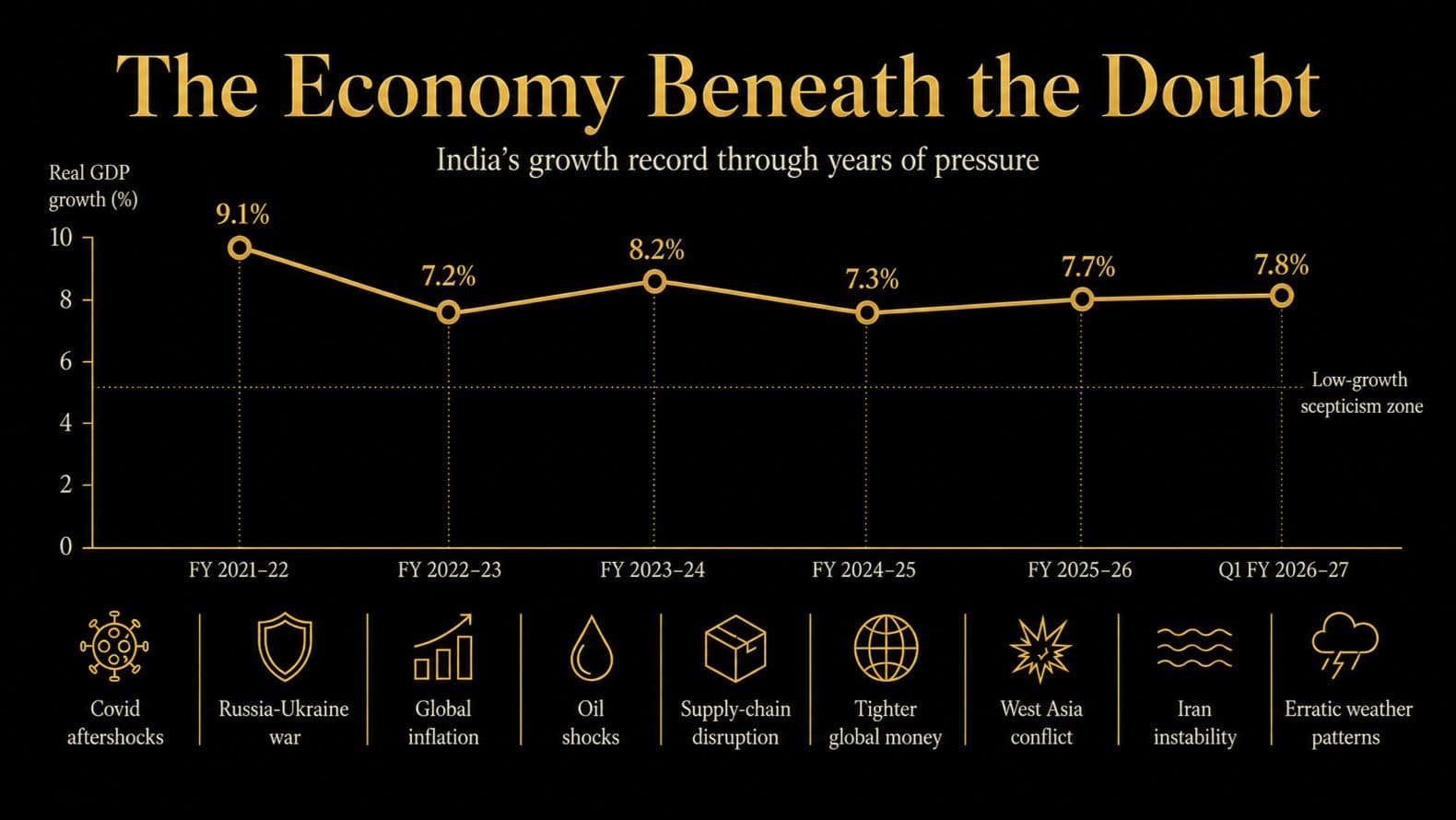
Beyond the 7.8% Headline: What the “Dead Economy” Remark Missed
When confidence in India’s post-Covid recovery was fragile, the then Chief Economic Adviser saw a 7% growth decade ahead. 5 years later, the latest 7.8% Q1 GDP print gives that call sharper context.
August 31, 2026

Can Sugar-Free Chocolate Become the Next Billion-Dollar Better-for-You Food Category?
Sugar-free chocolate, already a USD 2.6 billion global market, is projected to reach USD 4.86 billion by 2034, as better-for-you indulgence moves from niche demand toward mainstream consumption.
August 18, 2026
Industrial Cybersecurity Market: India’s Role In A USD 54.8 Billion Global Cyber-Resilience Opportunity
As factories, utilities & supply chains connect faster, India is emerging as a force in the USD 54.8 billion industrial cybersecurity market, where resilience will define the next industrial edge.
August 6, 2026