Intelligence
When Should a B2B Founder Consider Revenue-Based Financing Instead of Equity
At ₹5 crore ARR, financing shifts from access to fit. RBF, via Velocity and GetVantage, funds predictable growth without dilution. Equity is costly when you win, RBF when growth slows.
I
IndiSight Editorial
April 24, 20267 min read
At ₹5 Crore ARR, Equity May Already Be the Expensive Option
For years, the default financing path for a B2B SaaS founder was straightforward: build product, raise equity, scale and repeat. The assumption was simple. Equity is the fuel for growth.
That assumption is no longer universally true.
In 2026, founders are confronting a more precise question: what type of capital actually fits the stage and structure of the business? Not all capital behaves the same. Increasingly, using the wrong instrument is proving more expensive than not raising capital at all.
This is where Revenue-Based Financing has moved from the margins to the center of the conversation. Platforms like Velocity and GetVantage have built products designed specifically for companies with predictable revenue.
For B2B SaaS founders crossing ₹5 crore ARR, with gross margins above 65% and a functioning go-to-market engine, the choice is no longer obvious. In many cases, equity is already the more expensive option.
The Shift: From Capital Availability to Capital Fit
The distinction between equity and RBF is not just structural. It reflects what each form of capital is designed to do.
Equity funds uncertainty. It is meant for building products, entering new markets and taking long term bets where outcomes are unclear.
RBF funds predictability. It is designed to scale something that is already working. Sales, marketing and revenue generation that can be measured and repeated.
This distinction becomes meaningful once a company crosses early product market fit. At that point, capital is no longer required to discover growth. It is required to amplify it.
Amplification behaves differently from discovery. It can be measured, forecasted and in many cases financed without giving up ownership.
The Real Trade-Off: What You Pay and When
Most founders approach RBF with a simple mental model. Non dilutive capital is better.
That is incomplete.
RBF replaces dilution with a fixed repayment obligation, typically between 1.3x and 2.0x of the capital raised. The repayment is tied to revenue, usually as a percentage of monthly collections.
Equity, by contrast, has no repayment. But its cost is deferred and uncapped.
The only way to evaluate the trade off honestly is to look at outcomes across different scenarios.
Consider a company at ₹8 crore ARR raising ₹2 crore.
In a high growth scenario, where the company exits at ₹1,000 crore, giving up roughly 9% equity costs the founder about ₹90 crore in value. The same ₹2 crore raised through RBF at a 1.4x multiple would cost ₹2.8 crore. The difference is structural.
In a moderate outcome, say a ₹100 crore exit, that same dilution costs about ₹9 crore. RBF still costs ₹2.8 crore. The advantage remains but narrows.
The real test is the downside.
In a slowdown scenario, where growth weakens, the economics shift. The repayment multiple may move toward 1.8x. Total repayment increases to ₹3.6 crore and the repayment period stretches to two years. The effective cost rises sharply. In that situation, equity may have been cheaper.
This is the core truth founders need to internalise: Equity is expensive when you win. RBF is expensive when you slow down.
Where RBF Actually Works
RBF is not universally applicable. It works under specific operating conditions and those conditions are sharper than they appear.
Start with customer acquisition economics. RBF performs best when CAC payback is short. Current data shows median CAC payback across SaaS is approximately 15 months, with 18 months and beyond now falling into the bottom decile of performance.
This reframes the decision.
Companies with payback under 12 months remain ideal candidates. Those between 12 and 15 months are viable with discipline. Beyond that, repayment pressure begins to outweigh the benefits.
Retention tells a clearer story. Median NRR across Indian B2B SaaS sits at approximately 106%, but the top decile operates above 130%. That gap matters more than the median itself.
RBF providers price against predictability. Companies closer to 130% NRR behave like compounding systems. Those closer to 100% behave like linear businesses.
The former attracts better terms. The latter attracts caution.
What remains consistent is use of funds.
RBF works best when deployed into predictable, revenue generating activities such as sales hiring, paid acquisition and channel expansion. It performs poorly when used for product development or experimentation where outcomes are uncertain and timelines are long.
Using RBF as a Timing Tool
One of the more sophisticated uses of RBF is not as a substitute for equity but as a way to delay it.
This is where the Rule of X, popularised by Bessemer Venture Partners, becomes relevant.
The framework combines growth and profitability into a single metric:
Growth multiplied by a factor plus free cash flow margin.
For private companies, the multiplier remains approximately 2.0x. Higher multiples closer to 3.0x are typically reserved for public cloud companies.
A simple example illustrates the impact.
A company growing at 40% with 10% free cash flow margin has a score of 90. Another growing at 60% with 5% margin scores 125.
If RBF funded expansion helps a company move from the first profile to the second within a year, the valuation uplift at the next round can more than offset the cost of RBF.
This is not about cheap capital. It is about timing valuation correctly.
The Market Context: Why RBF Is Expanding
The rise of RBF in India is being shaped by both capital availability and regulatory clarity.
Lending by non bank financial institutions is growing at approximately 17.8% year on year, faster than traditional bank credit. This has expanded the pool of capital available for structured financing.
At the same time, the Reserve Bank of India has introduced measures that improve transparency and reduce risk.
The Default Loss Guarantee framework was formally notified on February 13, 2026. This allows lenders to factor guarantees into expected credit loss calculations, reducing effective borrowing costs by roughly 150 to 200 basis points compared to earlier periods.
Equally important, the Key Fact Statement mandate was introduced via RBI circular on April 15, 2024, with implementation deadlines extending to November 1, 2025 for complex lending structures. This requires all digital lending products to disclose full APR upfront.
Together, these changes have made RBF more transparent and more comparable to other forms of capital.
Choosing Between Providers
Provider choice is not just about terms. It is about fit.
Velocity operates primarily in the small to mid ticket segment, with typical SaaS financing extending up to approximately ₹10 crore. It is optimised for speed and standardisation.
GetVantage offers more flexibility, including larger and performance linked structures suited to more mature companies.
At the larger end of the market, platforms like Recur Club provide structured debt facilities that can extend up to ₹250 crore through products like Recur Scale. This sits in a different category from early stage RBF and is better understood as growth stage structured capital.
The trade off across providers is consistent.
Speed versus flexibility. Standardisation versus optimisation.
Neither model works well for companies with significant government revenue exposure. Payment cycles extending beyond 90 days create a mismatch between inflows and repayment obligations.
What Founders Must Check Before Signing
The decision to use RBF does not end with selecting a provider. It extends into the details of the agreement.
Founders should examine:
How revenue is defined for repayment calculations
Whether minimum repayment floors exist
Whether any prepayment penalties remain
Whether dilution triggers exist under stress scenarios
What renewal or follow on capital terms look like
What level of data access is required
Whether operational covenants restrict decision making
Whether revenue concentration clauses introduce penalties
Whether the disclosed APR matches actual repayment economics
The KFS requirement ensures disclosure. It does not eliminate the need for verification.
Where Incentives Diverge
RBF providers are aligned with founder outcomes but not perfectly.
They benefit when companies grow fast enough to repay capital but not so fast that they no longer need financing. This creates a subtle divergence.
More importantly, the wide repayment range of 1.3x to 2.0x introduces a pricing gradient. Providers earn more from companies priced at the higher end.
A founder receiving an offer at 1.8x is not being rejected. They are being priced for risk.
Approval signals eligibility. It does not confirm suitability.
The Emerging Pattern
The most effective founders are not choosing between equity and RBF. They are combining them.
Equity is used for product, hiring and long term bets. RBF is used for scaling revenue engines.
This avoids a common inefficiency. Using expensive equity to fund predictable growth.
What Happens Next
The current moment is favourable for RBF. Capital is available. Regulations are supportive. Pricing is transparent.
But underlying SaaS metrics are evolving. CAC payback has lengthened from peak efficiency levels. Retention has stabilised but remains uneven across cohorts.
These trends suggest that underwriting standards will tighten over the next 18 to 24 months.
Providers will price more conservatively and restrict access for borderline companies.
The implication is straightforward.
The window in which RBF is broadly accessible and economically attractive may be narrower than it appears today.
Founders who evaluate it now may secure better terms than those who wait.
In a market where capital structure quietly shapes long term outcomes, that decision may matter as much as the capital itself.
More Intelligence
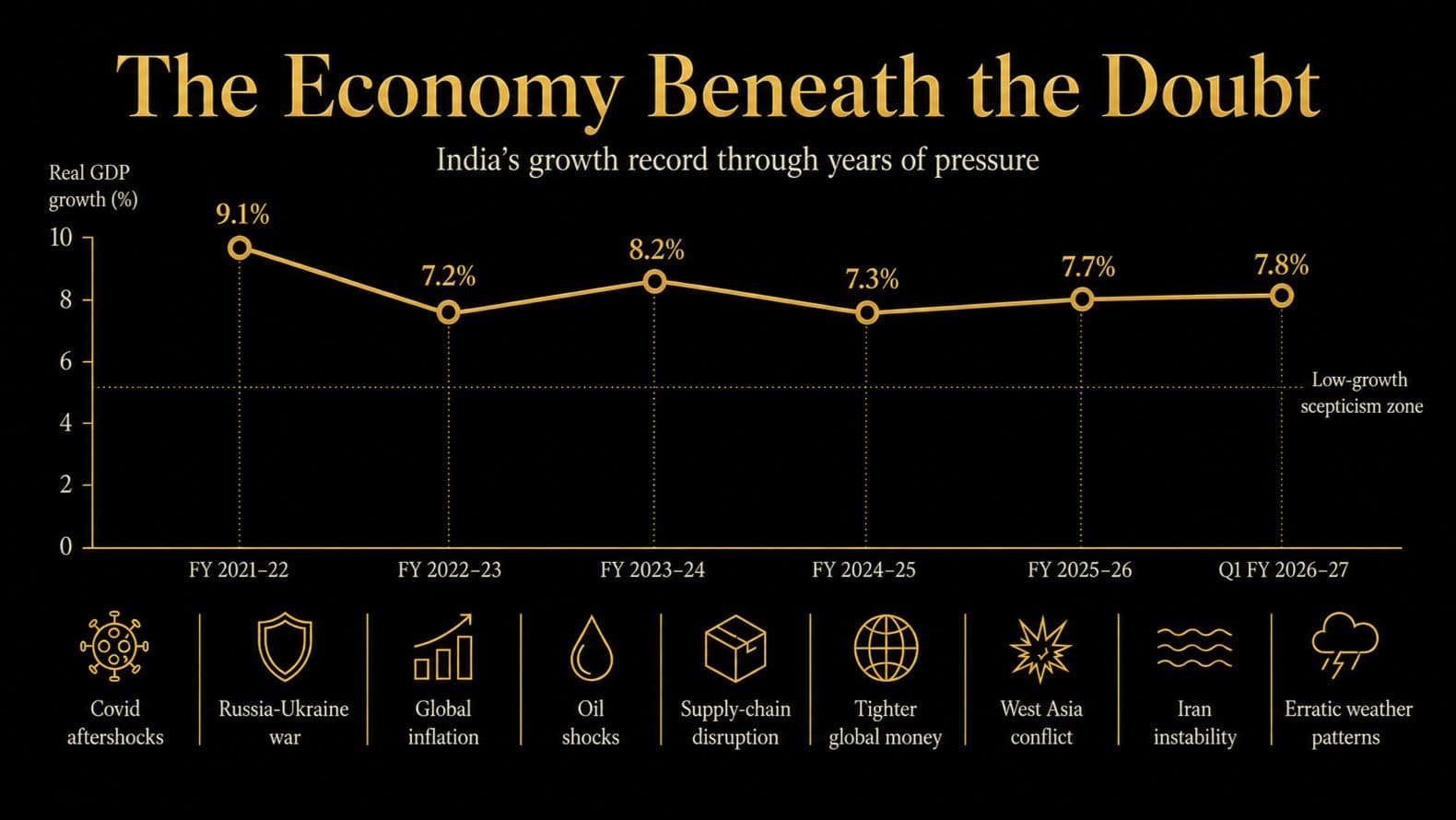
Beyond the 7.8% Headline: What the “Dead Economy” Remark Missed
When confidence in India’s post-Covid recovery was fragile, the then Chief Economic Adviser saw a 7% growth decade ahead. 5 years later, the latest 7.8% Q1 GDP print gives that call sharper context.
August 31, 2026

Can Sugar-Free Chocolate Become the Next Billion-Dollar Better-for-You Food Category?
Sugar-free chocolate, already a USD 2.6 billion global market, is projected to reach USD 4.86 billion by 2034, as better-for-you indulgence moves from niche demand toward mainstream consumption.
August 18, 2026

Industrial Cybersecurity Market: India’s Role In A USD 54.8 Billion Global Cyber-Resilience Opportunity
As factories, utilities & supply chains connect faster, India is emerging as a force in the USD 54.8 billion industrial cybersecurity market, where resilience will define the next industrial edge.
August 6, 2026