Intelligence
India’s AI Spending Boom Is Deepening the Pilot Trap
India’s AI boom is fueling pilots, not scale. Despite rising investment, few initiatives reach production. The real challenge is not technology, but execution.
I
IndiSight Editorial
April 24, 20266 min read
Rising investment is not accelerating adoption. It is exposing how hard execution really is.
In 2024, India’s artificial intelligence story acquired the weight of inevitability.
Enterprises announced more than ₹8,000 crore in AI spending. The government followed with the ₹10,372 crore IndiaAI Mission, a signal amplified by the Press Information Bureau. Capital, policy, and talent appeared to be aligning at once. In boardrooms, the conclusion felt straightforward: the technology was ready; the ecosystem had matured; scale would follow.
What remained, it was assumed, was execution.
That assumption is now beginning to look misplaced.
Across Indian enterprises, AI activity has surged. Pilots are multiplying, use cases are expanding, and experimentation has become routine. Yet the share of initiatives that make it into production at scale remains stubbornly small. The system is moving faster, but not further.
This is the pilot trap. And India is deep in it.
The illusion of momentum
By most surface measures, adoption looks strong. Roughly 85 percent of large enterprises report some form of AI engagement, according to NASSCOM’s adoption index. Internally, companies have set up AI centers of excellence, allocated budgets, and partnered with vendors. The language of transformation is everywhere.
But beneath that activity lies a different pattern.
Fewer than one in ten AI initiatives reach production at scale, based on industry estimates drawing from analyses by institutions such as MIT and Tata Consultancy Services. Pilot volumes have grown sharply over the past three years, while deployments have inched forward.
The gap between the two is no longer incidental. It is structural.
More tellingly, it is widening.
As experimentation becomes cheaper and tools more accessible, enterprises are launching more pilots than they can realistically absorb. Each one, in isolation, appears justified. Together, they create a fragmented landscape of partially developed systems; proofs of concept that never quite become part of the business.
The pipeline is expanding at the top. The base is not keeping up.
Where pilots succeed. And why they fail
Pilots are designed to work.
They operate in controlled environments, with curated datasets and tightly scoped objectives. Teams are aligned, variables are limited, and success is often measured narrowly. Under these conditions, models perform well. Results look promising.
Production environments are the opposite.
Data moves across systems that were never built to work together. Decision-making is spread across multiple layers. And workflows reflect years of small fixes rather than intentional design.
When AI systems move into this environment, friction emerges quickly. Models struggle with inconsistent data. Approval cycles slow progress. Employees revert to familiar processes when new tools introduce ambiguity.
The challenge is no longer technical. It is organisational.
And in India, three constraints make that transition particularly difficult.
The weight of legacy
What companies often describe as a data problem is, in reality, a legacy problem.
Many large Indian enterprises still run on systems built for a different era: early ERP implementations, heavily customised layers designed for compliance, and architectures optimised for record-keeping rather than interoperability. These systems fragment data and limit how easily it can be integrated into modern AI pipelines.
The limitation becomes sharper with newer forms of AI. Systems are no longer expected only to generate insights; they are expected to act. That requires deep integration with operational workflows’ something legacy architectures struggle to support.
During pilots, these constraints are often masked. In production, they surface immediately.
Fixing them is neither quick nor cheap. It requires rethinking data architecture, investing in integration layers, and prioritising long-term capability over short-term wins. Many organisations hesitate at this point. Progress stalls.
Governance as a new bottleneck
A second layer of friction is coming from regulation.
India’s AI governance guidelines, introduced in early 2026, were meant to bring clarity through a graded liability framework. In reality, they have made a system that was moving fast a bit more cautious.
Enterprises are now looking at AI initiatives through a legal and compliance lens. Questions around data usage, model behaviour, and accountability are getting closer scrutiny. Projects that once moved quickly as pilots are now facing longer review cycles before they can be deployed.
When there is no clear precedent, caution tends to take over.
Governance, in this sense, is not a barrier. But it does slow things down.
The quiet resistance of organisations
The deepest constraint is cultural.
AI systems do more than automate tasks; they make processes visible. Decisions become traceable, performance becomes measurable, and long-standing ambiguities are reduced. For organisations built on hierarchy and tacit knowledge, this shift can be unsettling.
Resistance rarely appears as outright opposition. It shows up in subtler ways: delayed adoption, increased scrutiny, or a preference for existing workflows. Middle management, in particular, often finds itself absorbing the additional burden.
A 2026 workforce report by Tata Consultancy Services found that 60 percent of managers believe AI tools increase oversight responsibilities without reducing core expectations. The technology, in other words, feels like added work rather than leverage.
When incentives do not change, behaviour does not either.
A harder path than peers
India’s challenge becomes clearer in comparison.
In the United States, a decade-long shift toward cloud-first infrastructure has created a foundation where AI systems can integrate more easily into enterprise operations.
China, by contrast, has pursued a more centralised model, building state-supported AI infrastructure tailored to specific industries, allowing faster deployment in targeted sectors.
India is attempting both transitions at once: moving to the cloud, modernising data systems, and deploying AI simultaneously. Each is complex on its own. Together, they slow execution.
The pilot trap is, in part, a consequence of this overlap.
When more money makes things harder
There is a persistent belief that capital accelerates adoption.
In AI, it often does the opposite.
More investment lowers the cost of experimentation. Enterprises launch more pilots, test more ideas, and engage more vendors. But the capacity to integrate these efforts into production does not expand at the same rate.
The result is an imbalance: experimentation outpaces absorption.
Over time, organisations accumulate unfinished initiatives. Attention fragments, resources thin out, and decision-making becomes slower under the weight of competing priorities.
The system becomes busier, but not more effective.
What a different approach looks like
A small group of companies is beginning to take a more disciplined path.
Instead of trying to do everything at once, they’re choosing to do a few things really well, picking critical workflows and embedding AI into them end to end. That means rethinking how the work actually gets done, aligning incentives, and sticking with it long enough to see results.
Structure plays a big role here. When AI sits in isolated centres of excellence, it rarely changes how the business truly operates. But when business units own it and are accountable for real outcomes, it’s far more likely to take hold.
In this case, focus isn’t a limitation. It’s a deliberate strategy.
The implication for builders
For founders and product teams, the lesson is clear.
Technical proficiency, though essential, does not guarantee success. Achieving desired outcomes necessitates managing disparate data sources, adjusting to evolving regulatory landscapes, and integrating AI into established workflows that frequently exhibit resistance to modification. The primary obstacle in enterprise AI implementation lies not in the construction of sophisticated models, but rather in their practical application. Organizations that emphasize integration and user adoption, rather than solely focusing on performance metrics, will ultimately gain a competitive advantage.
The distance that remains
India’s AI push has enabled a broad wave of experimentation. That, in itself, is an achievement.
But experimentation is not transformation.
Progress will likely come from a smaller set of organisations willing to commit deeply within a defined scope’ to pick a critical workflow and rebuild it around AI with clear accountability for outcomes.
For the rest, activity will continue to rise. Pilots will multiply. Announcements will accumulate.
And the distance between what is tested and what is truly deployed will remain the clearest measure of how difficult execution still is.
More Intelligence
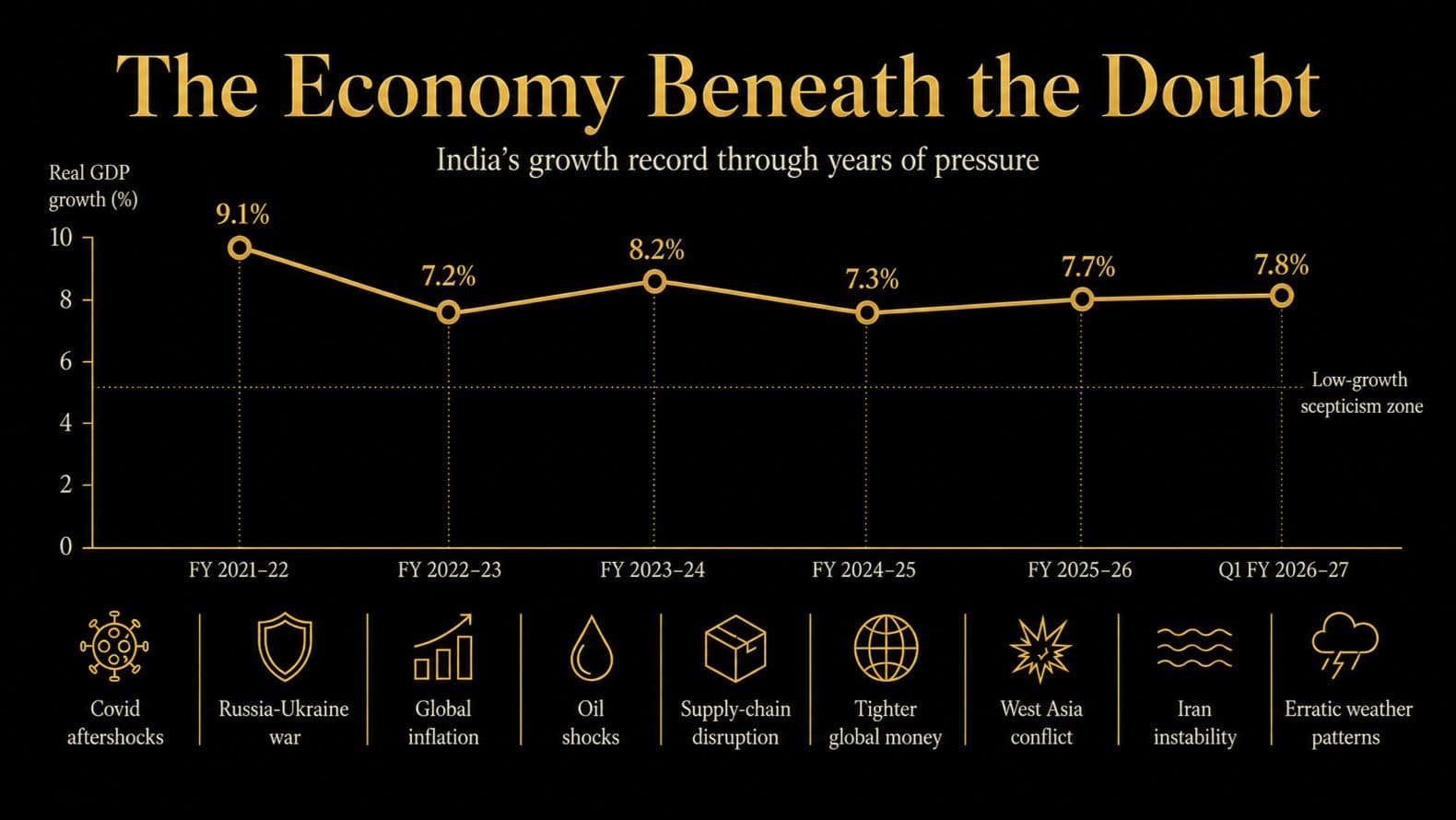
Beyond the 7.8% Headline: What the “Dead Economy” Remark Missed
When confidence in India’s post-Covid recovery was fragile, the then Chief Economic Adviser saw a 7% growth decade ahead. 5 years later, the latest 7.8% Q1 GDP print gives that call sharper context.
August 31, 2026

Can Sugar-Free Chocolate Become the Next Billion-Dollar Better-for-You Food Category?
Sugar-free chocolate, already a USD 2.6 billion global market, is projected to reach USD 4.86 billion by 2034, as better-for-you indulgence moves from niche demand toward mainstream consumption.
August 18, 2026

Industrial Cybersecurity Market: India’s Role In A USD 54.8 Billion Global Cyber-Resilience Opportunity
As factories, utilities & supply chains connect faster, India is emerging as a force in the USD 54.8 billion industrial cybersecurity market, where resilience will define the next industrial edge.
August 6, 2026