Intelligence
The Credential Is Dead. Long Live the Skill-Stack.
Degrees are losing relevance as AI reshapes work, giving rise to skill-stacks—dynamic, verifiable competencies that reflect what professionals can do, not just what they learned.
I
IndiSight Editorial
June 29, 20269 min read
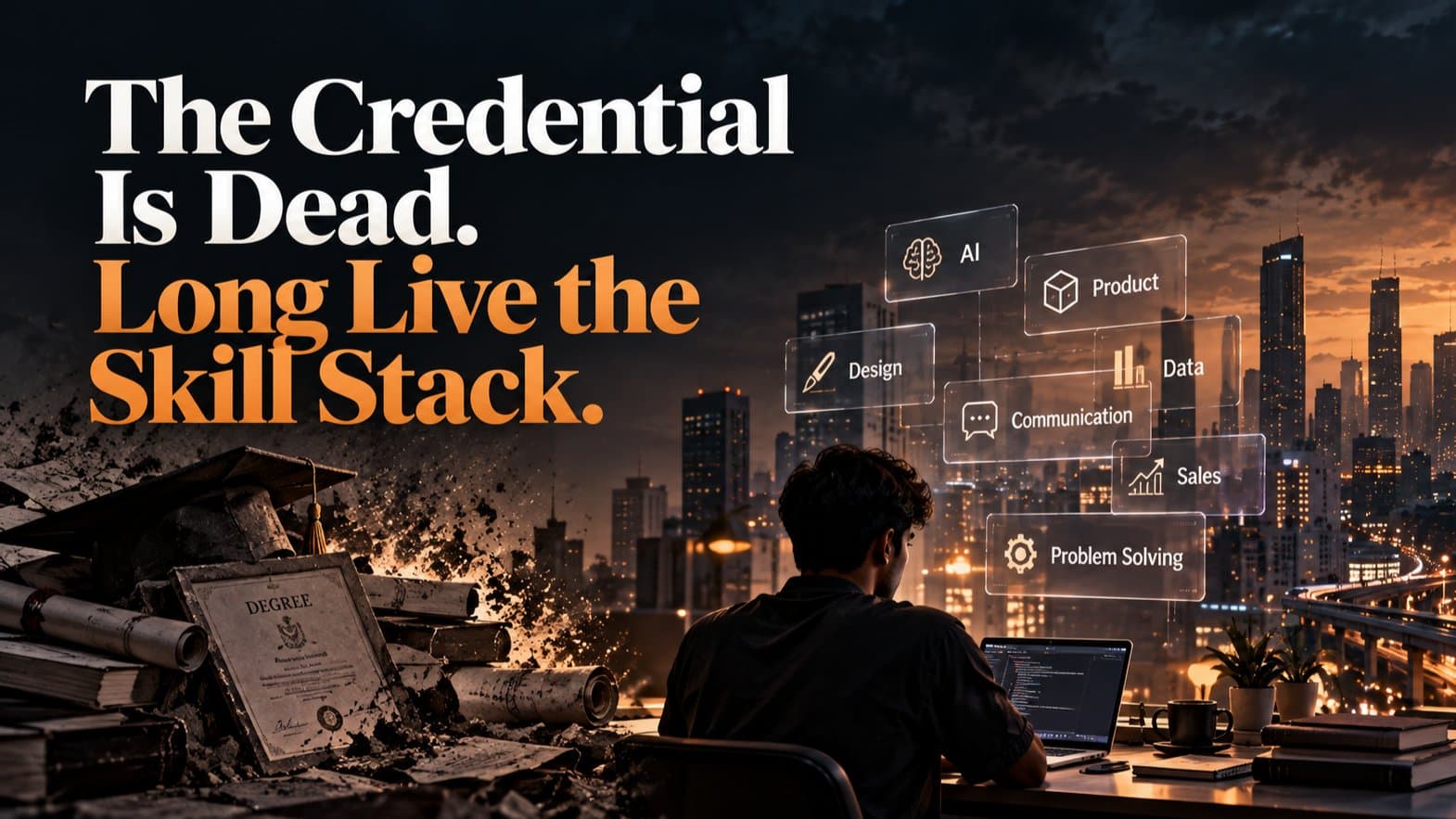
There is a crisis unfolding inside some of the world's most respected institutions of higher learning, and it has nothing to do with funding cuts or enrollment declines. It is a crisis of relevance. The degree, that time-honored signal of professional readiness, the credential that structured careers and conferred legitimacy for the better part of a century, is losing its authority in the labor market. Not dramatically, not all at once, but steadily and, at this point, irreversibly.
What is replacing it is more complex, more dynamic, and perhaps in many ways more demanding. The organizing concept of professional development in 2026 is the Skill-Stack: a modular, verified, continuously updated portfolio of competencies that reflects not what an individual once learned, but what they can demonstrably do today. For professionals navigating an economy increasingly shaped by artificial intelligence, this distinction is not semantic. It is the difference between a career that compounds and one that erodes.
Understanding how this shift happened, what it requires, and where it is heading is among the most consequential strategic questions facing India's working professionals, educational institutions, and the companies that employ both.
How We Arrived Here
The proximate cause of this transformation is the rapid integration of AI into the cognitive fabric of professional work. As AI tools have become capable of performing, with increasing reliability and speed, the routine analytical, research, writing, and synthesis tasks that once formed the daily workload of knowledge workers, the value of knowing how to do those tasks has declined. What has risen in value is the capacity to direct, interrogate, integrate, and judge the outputs of systems that can perform them.
This shift has exposed a fundamental inadequacy in the traditional educational model. A degree, by design, is a retrospective credential. It certifies that a person acquired a defined body of knowledge at a specific point in time, in a curriculum that was itself designed years or decades earlier. In a stable professional environment, where the half-life of skills is measured in decades, this model functions reasonably well. In an environment where the tools, tasks, and competency requirements of professional work are evolving on a timescale of months, it functions poorly.
The labor market has noticed. Global data from 2026 shows a significant and accelerating decline in mandatory degree requirements across job postings, with employers increasingly specifying verified skill competencies: AI fluency, systems thinking, specific technical or domain capabilities, as the primary hiring signals. Academic pedigree retains some weight, particularly in sectors where credentials carry regulatory or reputational significance. But its role as a proxy for professional readiness is being systematically displaced.
The Architecture of the Skill-Stack
The Skill-Stack is not simply a list of courses completed or certifications earned. At its most effective, it is a structured, layered collection of competencies, ranging from technical and domain-specific skills at the base to higher-order cognitive and interpersonal capabilities at the apex, that is continuously refreshed to reflect both market demand and individual development.
What distinguishes the Skill-Stack from its predecessors is verifiability and modularity. Rather than a single credential that represents a broad and undifferentiated body of learning, the Skill-Stack is composed of discrete, demonstrable competencies, each of which can be independently verified, updated, or replaced as requirements evolve. A professional in this model is not defined by where they studied a decade ago, but by what they can prove they can do today.
For Indian professionals, this architecture carries particular significance. India's workforce is among the youngest and most rapidly growing in the world, and the challenge of aligning that workforce with the demands of an AI-integrated economy is both urgent and consequential at national scale. The transition from a degree-centric to a skills-centric labor market does not, in principle, disadvantage those who entered the workforce through non-elite institutions or non-traditional pathways, provided that the systems for verifying and signaling competency are genuinely meritocratic. This is one of the more promising dimensions of the shift, and one that India's policymakers and educators would do well to lean into aggressively.
The "Dual Readiness" Imperative
One of the more nuanced and important concepts to emerge from 2026's education research is what practitioners are calling "Dual Readiness": the ability to work fluidly with AI-augmented tools when they are available, and competently without them when they are not.
The concept may seem straightforward, but its implications for curriculum design and professional development are substantial. The dominant pattern in AI adoption across professional contexts has been a rapid shift toward AI-assisted work, in which individuals increasingly rely on AI tools to perform tasks they once performed independently. The efficiency gains are real and well-documented. But so, increasingly, is the risk.
Causal research published in 2026 has identified what might be called the "short-term boost trap", the pattern in which AI tools produce immediate and measurable improvements in task performance that disappear when individuals are assessed without AI access. The gains were in the output, not in the capability. The professional became more productive in the short term while becoming, in an important sense, less capable in the long term.
This finding has significant implications for how both individuals and organizations should think about AI integration. The goal is not to use AI to substitute for human capability but to use it to extend and develop it. To handle the lower-order tasks that free up cognitive bandwidth for the higher-order work that builds genuine competency. A curriculum, a professional development program, or a personal learning strategy that does not intentionally preserve space for "productive struggle", for working through difficult problems without the assistance of an AI system, is, the evidence suggests, building on sand.
What the Platforms Are Becoming
The educational infrastructure evolving to support this new model looks substantially different from the institutions and platforms of even five years ago.
The most sophisticated learning platforms in 2026 have moved well beyond their origins as video libraries or digital classrooms. They function, at their best, as what researchers describe as metacognitive scaffolds: systems that analyze individual performance data, identify competency gaps in real time, and generate personalized pathways of modular learning that are continuously updated as both the individual's profile and the broader skills landscape evolve.
AI is not merely a feature of these platforms; it is their organizing architecture. It serves simultaneously as a personalized tutor, feedback engine, and curriculum designer, adapting content, pacing, and difficulty to the specific needs of each learner rather than delivering a standardized experience to a cohort. The effect, when well-implemented, is a form of learning at scale that retains much of the pedagogical value of individualized instruction, a combination that traditional education systems have historically been unable to achieve.
For professionals in India's rapidly growing technology, services, and manufacturing sectors, the practical implication is that access to high-quality, relevant professional development is less dependent than it once was on geography, institutional affiliation, or employer investment. The infrastructure for building a genuine Skill-Stack is increasingly available to anyone with the discipline to use it.
The Competencies That Matter Most
Across the research literature on professional development in the AI era, a relatively consistent picture has emerged of which human capabilities are most valuable and most at risk of neglect in an environment of heavy AI reliance.
AI fluency and critical literacy sit at the foundation. The ability to use AI tools effectively, to prompt them well, to interrogate their outputs, to recognize their limitations and biases, and to synthesize their contributions with independent judgment, is rapidly becoming a baseline professional competency rather than a specialized skill. Professionals who cannot work fluidly with AI systems will be structurally disadvantaged in most knowledge-work environments. But so, increasingly, will professionals who cannot work critically on them.
Above this foundation, the skills that have appreciated most in the AI era are precisely those that automation handles least well.
Communication: the ability to construct, deliver, and adapt an argument for a specific audience, remains irreducibly human.
Ethical judgment: the capacity to navigate situations where the right course of action is contested or contextually complex, cannot be reliably delegated to a system trained on historical data.
Collaborative intelligence: the ability to work effectively with other people, to build trust, to manage conflict, and to generate outcomes that individuals could not achieve alone, is not a skill that AI augments so much as one that it cannot replace.
And underlying all of these is what researchers increasingly identify as the most foundational competency of the current era: metacognition. The ability to manage one's own learning, to assess one's competency honestly, to identify gaps deliberately, and to adapt continuously to shifting requirements, is, in an environment of perpetual technological change, the skill that makes all other skill development possible.
The Risks That Demand Honest Acknowledgment
The transition to a skills-first, AI-integrated learning model carries genuine risks that neither optimism nor commercial interest should be permitted to paper over.
The equity dimension is the most structurally concerning. Access to sophisticated AI learning tools is not uniform. Professionals in resource-rich environments, employed by large companies, enrolled in well-funded institutions, or simply able to pay for premium platforms, have access to personalized, adaptive, high-quality learning infrastructure. Those in under-resourced environments, including large segments of India's workforce outside of major urban centers, do not. If the shift to skills-based professional development reproduces and amplifies existing inequalities rather than dissolving them, its net effect on the labor market will be significantly less progressive than its proponents claim.
The "AI anxiety" dynamic identified in recent research adds a further layer of complexity. Studies have found that heavy reliance on AI tools for tasks like writing and problem-solving can paradoxically erode learners' confidence in their independent capabilities, creating a cycle in which anxiety about performance drives further reliance on AI assistance, which in turn reinforces the underlying anxiety. Professionals and institutions that recognize this pattern and design learning experiences that actively build independent confidence, rather than simply optimizing for measurable output, are addressing a dimension of the transition that is easy to overlook.
A Strategic Moment for India
India finds itself at an inflection point in this story. A workforce of enormous scale and youth, a technology sector of genuine global significance, a set of structural advantages in services and manufacturing, and an educational system that is, with urgency, renegotiating its relationship with all of them.
The transition from degrees to Skill-Stacks is not a threat to India's professional classes. It is, potentially, an opportunity of considerable magnitude. A labor market that values verified competency over credentialed pedigree is, in principle, more meritocratic and more accessible to the millions of talented professionals who built their capabilities outside the institutions historically treated as gatekeepers.
Capturing that opportunity requires clarity about what the transition demands: not the passive adoption of AI tools, but the active construction of the human capabilities that AI cannot replicate; not the abandonment of rigorous learning, but its radical reimagination; not the replacement of educational institutions, but their fundamental reinvention.
The credential is not dead. But its era of uncontested authority is over. What comes next will be built by those who understand, clearly and without nostalgia, what has changed, and why.
More Intelligence
Beyond the 7.8% Headline: What the “Dead Economy” Remark Missed
When confidence in India’s post-Covid recovery was fragile, the then Chief Economic Adviser saw a 7% growth decade ahead. 5 years later, the latest 7.8% Q1 GDP print gives that call sharper context.
August 31, 2026

Can Sugar-Free Chocolate Become the Next Billion-Dollar Better-for-You Food Category?
Sugar-free chocolate, already a USD 2.6 billion global market, is projected to reach USD 4.86 billion by 2034, as better-for-you indulgence moves from niche demand toward mainstream consumption.
August 18, 2026

Industrial Cybersecurity Market: India’s Role In A USD 54.8 Billion Global Cyber-Resilience Opportunity
As factories, utilities & supply chains connect faster, India is emerging as a force in the USD 54.8 billion industrial cybersecurity market, where resilience will define the next industrial edge.
August 6, 2026