Intelligence
Beyond Bangalore: Why India's Next Startup Wave Is Being Built in the Heartland
India’s startup map is shifting beyond metros, as digital infrastructure, distributed talent, and lower costs enable Tier-2 cities to build scalable, specialized companies with real competitive edge.
I
IndiSight Editorial
June 29, 20268 min read
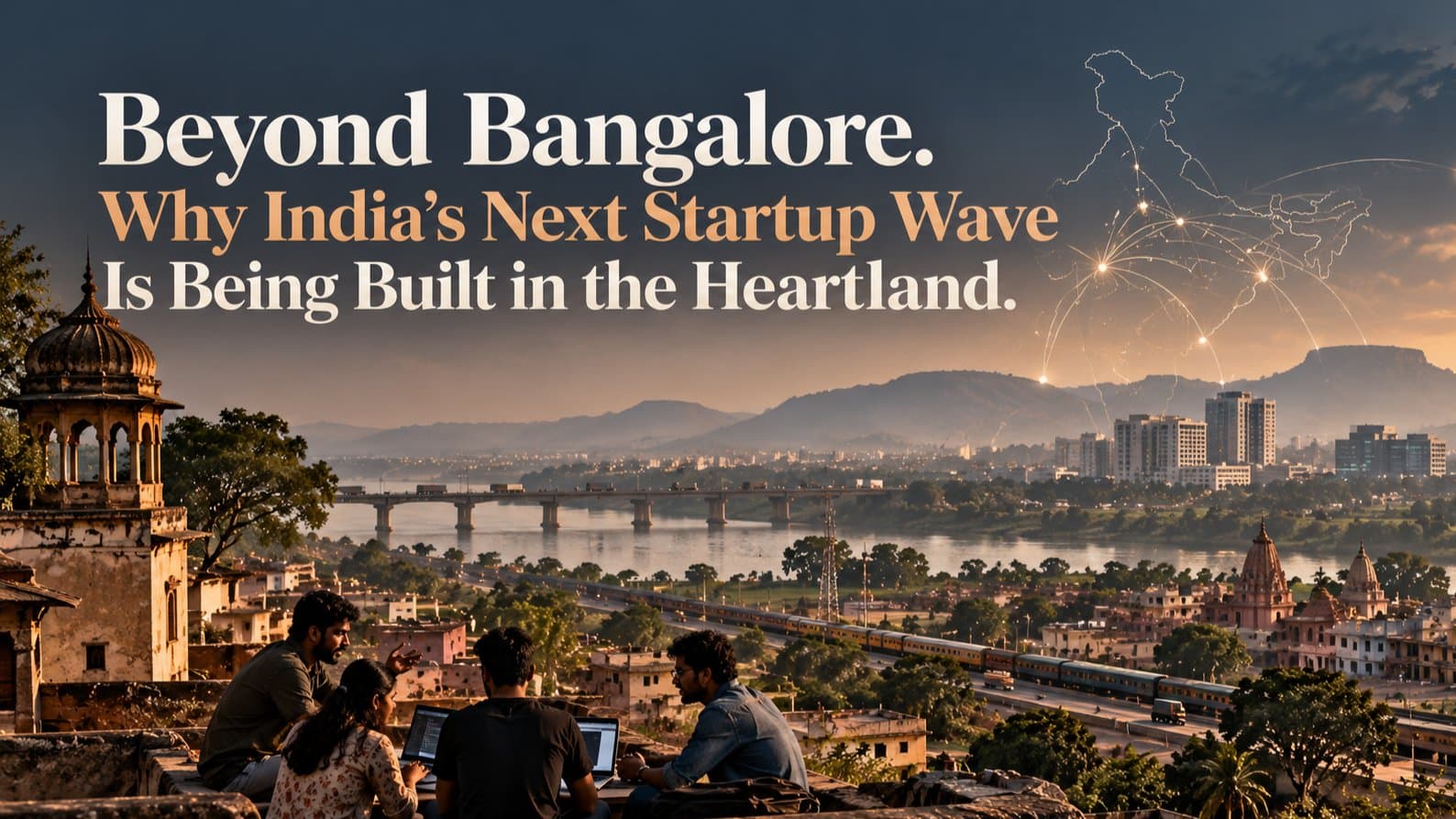
For much of the past two decades, the geography of Indian innovation was effectively a triangle. Bangalore anchored the south, Delhi-NCR commanded the north, and Mumbai provided the financial gravitational pull from the west. To build a serious startup in India was, for most founders, a decision that preceded all others: relocate to one of these three metros, absorb the cost, accept the culture, and compete for the same talent pool as every other ambitious company on the same street.
That geography is being redrawn.
By mid-2026, approximately half of all startups recognized under the DPIIT framework originate from Tier-2 and Tier-3 cities. This is not a rounding error or a statistical artifact of broadening recognition criteria. It is the most significant structural shift in the composition of India's startup ecosystem since the early growth of Bengaluru's technology corridor and it carries consequences that most founders, investors, and policymakers have not yet fully absorbed.
A Shift in the Foundations, Not Just the Geography
The temptation when observing this trend is to treat it as a story about cost arbitrage; founders discovering that Jaipur is cheaper than Koramangala, or that Indore offers a quieter competitive environment than Gurugram. Cost is certainly part of the equation, but framing the shift primarily in those terms misses the more consequential dynamic at work.
What has changed is the underlying infrastructure that made metro concentration necessary in the first place.
For the better part of two decades, building a nationally relevant startup from a smaller city was structurally difficult. Access to customers required distribution infrastructure that was disproportionately concentrated in metros. Access to payment systems, logistics networks, and digital commerce rails required relationships or physical presence that smaller cities simply could not offer. And access to senior talent, the product managers, growth leads, and engineering architects who define the trajectory of early-stage companies, was almost exclusively a metro phenomenon.
Each of these constraints has been materially weakened, and in some cases eliminated, by developments that converged around 2025 and 2026.
Three Forces Rewriting the Playbook
The Digital Public Infrastructure Layer
The maturation of India's Digital Public Infrastructure and in particular the emergence of the Open Network for Digital Commerce (ONDC), has functioned as a structural equalizer in ways that few other policy interventions have achieved.
Prior to ONDC, the pathway to national-scale retail for a startup in Kanpur or Vadodara ran through the major e-commerce platforms, each with its own commission structures, algorithmic preferences, and de facto barriers to visibility for smaller or newer sellers. Market access was real, but it was mediated and stratified.
ONDC changes the terms of participation. By building an interoperable, open network that any seller can integrate with and any buyer can access through any participating interface, it eliminates the leverage that platform ownership previously conferred. For a startup in Coimbatore or Thiruvananthapuram, integration into ONDC now provides access to the same national customer base, the same logistics rails, and the same payment infrastructure as incumbents with decade-long platform relationships.
The competitive dynamic this creates is worth stating plainly: it shifts the basis of competition from platform ownership to service quality. For startups with a genuinely differentiated product or a superior customer experience, this is an unambiguously favorable shift.
The 5G rollout has reinforced this dynamic. The connectivity gap between metro and non-metro India, once a genuine operational constraint for technology companies, has narrowed substantially. A product team in Surat or Jaipur can build, test, iterate, and ship with essentially the same digital infrastructure as one operating out of a Bengaluru tech park.
The Reverse Brain Drain
The second structural shift is human rather than infrastructural. Since 2025, the normalization of hybrid and distributed work models has catalyzed a significant and sustained return of skilled professionals to their hometowns and smaller cities.
The implications for Tier-2 startup ecosystems have been immediate and substantial. Cities that previously lacked the senior talent density necessary to staff an ambitious early-stage company have gained access, sometimes rapidly, to professionals with the kind of experience that previously required a metro address to cultivate. The product manager who spent six years at a Bengaluru unicorn and has returned to Indore to be closer to family brings with her not just skills but networks, mental models, and institutional knowledge that are now available to the local ecosystem.
This is not merely a quantitative change in talent availability. It is a qualitative shift in the maturity ceiling of what Tier-2 ecosystems can build. Companies in these markets can now recruit for roles that, until very recently, could only be filled by relocating to a metro, or paying the premium to attract someone who was unwilling to leave one.
Operational Arbitrage and Runway Extension
The cost dimension, while not the primary story, is real and strategically significant. For early-stage founders, the arithmetic of building in a Tier-2 city versus a Tier-1 hub is compelling. Lower office costs, stabilized local talent compensation, and reduced cost-of-living pressures on employees translate directly into extended runway, which, for a pre-product-market-fit company, is among the most consequential variables determining survival.
The less quantified but equally important dimension is what might be called signal clarity. The competitive intensity of metro ecosystems, while valuable in some respects, also introduces noise. The pressure to raise at inflated valuations, to hire at metro-competitive salaries before the revenue base warrants it, and to optimize for visibility rather than fundamentals is subtler in smaller cities. Founders in these markets consistently report that the environment is more conducive to the patient, methodical work of building products and understanding customers.
The Specialization of the Heartland
What is particularly striking about the current moment is that Tier-2 cities are not emerging as generic alternatives to metros. They are developing distinctive specializations, often rooted in existing economic and cultural strengths.
Jaipur's deep heritage in design, craft commerce, and creative industries is producing a cluster of D2C and creative technology companies that leverage the city's established networks in these domains. Indore, anchored by a strong base of IIM and IIT alumni who have returned or remained, is becoming a center for technology services and scaling operations. Coimbatore's proximity to industrial manufacturing clusters is driving the emergence of manufacturing technology and industrial automation startups. Surat, with its deeply entrepreneurial commercial culture and its position at the center of India's textile and diamond trade, is producing fintech and trade-technology companies with genuine domain expertise built into their DNA.
This specialization matters because it suggests something more durable than a cost-driven relocation trend. When a city's startup ecosystem aligns with its existing economic identity, the resulting companies tend to have embedded advantages: access to domain expertise, established industry relationships, and a customer base that is proximate rather than abstract, that are difficult to replicate from the outside.
The Challenges That Remain Real
An honest account of this shift requires acknowledging the structural constraints that have not yet been resolved. The momentum is genuine; so are the gaps.
The venture capital ecosystem, despite the growth of state-level initiatives and seed funds, remains heavily weighted toward Tier-1 geographies. Founders raising beyond the seed stage consistently report that access to Series A and B capital requires either a physical presence in a metro hub or a network that effectively substitutes for one. The investors making those decisions are, in the main, still based in Bangalore, Mumbai, and Delhi, and the relational dynamics that accelerate fundraising continue to reward proximity.
Specialized talent, while less scarce than it was three years ago, remains unevenly distributed. Generic engineering talent has followed the reverse brain drain and is now reasonably available across major Tier-2 markets. But deep-tech architects, senior AI and machine learning practitioners, and experienced product growth leaders remain disproportionately concentrated in the metros. Founders navigating this constraint have largely arrived at the same pragmatic solution: build core engineering and operational teams in their Tier-2 base, while maintaining a presence, however lean, in a metro for roles that require that talent density.
Finally, there is the more intangible challenge of network serendipity. The accidental meeting, the investor encountered at a coffee shop, the potential co-founder introduced through a shared workspace, the mentor relationship that begins at an industry dinner, is a genuine feature of metro ecosystems that Tier-2 cities have not yet replicated at scale. Founders who have built successfully in smaller cities tend to compensate through deliberate digital community-building and periodic, intentional visits to metro hubs for concentrated periods of networking. The serendipity is manufactured rather than ambient, which requires more intentionality but is not, in practice, an insurmountable constraint.
The Hybrid Geography Model
The strategic synthesis that has emerged from founders navigating this landscape successfully in 2026 is not a binary choice between Tier-1 and Tier-2. It is what might be called the Hybrid Geography Model, a deliberate decoupling of where a company builds from where it accesses capital, senior talent, and enterprise relationships.
The practical architecture looks roughly like this: core product development, engineering, and operational infrastructure is built in a Tier-2 city, leveraging the cost advantages, workforce loyalty, and reduced competitive noise of that environment. Metro hubs are used selectively and strategically, as nodes for fundraising cycles, for recruiting senior leadership, and for the high-touch enterprise sales relationships that still benefit from physical proximity.
The insight embedded in this model is that the metro's value is real but specific. It is not a general-purpose advantage that justifies the full cost of metro-based operations. It is a set of particular access benefits: to capital, to certain talent, to certain relationships, that can be obtained without headquartering the entire company in an expensive, high-friction environment.
For the previous generation of Indian startups, this decoupling was not practically available. The infrastructure dependencies that tied innovation to metros were too fundamental. What 2026 represents is the moment at which those dependencies have been sufficiently weakened that the decoupling becomes not just theoretically possible, but operationally straightforward.
What This Means for the Decade Ahead
The redistribution of India's startup activity beyond its three traditional metro anchors is not a trend that is likely to reverse. The infrastructure investments underpinning it, in digital public goods, in connectivity, in the normalization of distributed work, are durable. The talent dynamics driving the reverse brain drain reflect preferences and life priorities that have shifted structurally, not cyclically.
What this creates, for founders willing to build with this geography in mind, is an enduring set of competitive advantages: lower capital requirements, higher workforce stability, embedded domain expertise, and the kind of operational focus that comes from building in an environment where the noise-to-signal ratio is genuinely lower.
India's next generation of category-defining companies may well carry Bengaluru or Mumbai addresses on their incorporation documents. But they will increasingly be built, product by product, customer by customer, somewhere else entirely.
More Intelligence
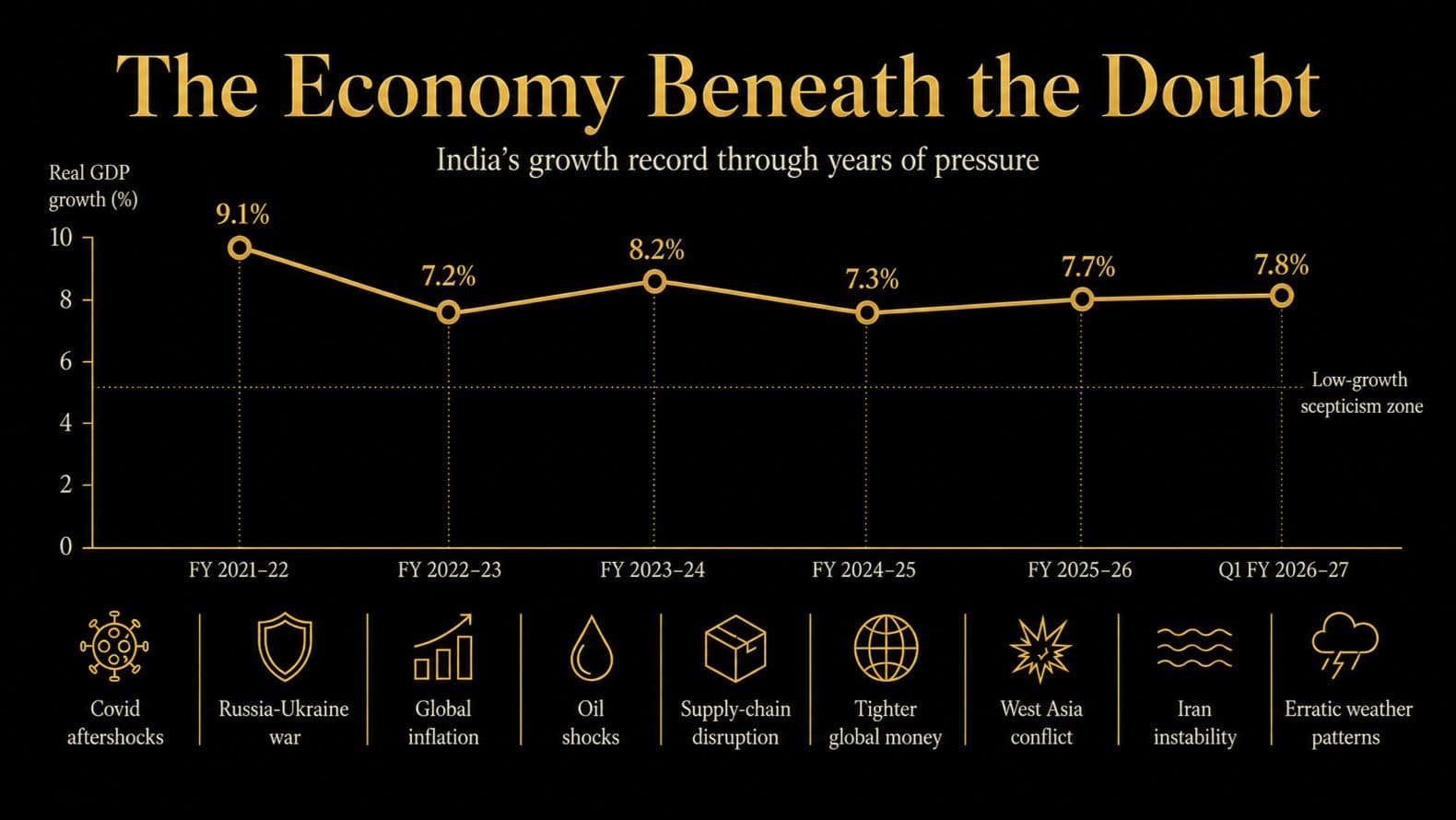
Beyond the 7.8% Headline: What the “Dead Economy” Remark Missed
When confidence in India’s post-Covid recovery was fragile, the then Chief Economic Adviser saw a 7% growth decade ahead. 5 years later, the latest 7.8% Q1 GDP print gives that call sharper context.
August 31, 2026

Can Sugar-Free Chocolate Become the Next Billion-Dollar Better-for-You Food Category?
Sugar-free chocolate, already a USD 2.6 billion global market, is projected to reach USD 4.86 billion by 2034, as better-for-you indulgence moves from niche demand toward mainstream consumption.
August 18, 2026
Industrial Cybersecurity Market: India’s Role In A USD 54.8 Billion Global Cyber-Resilience Opportunity
As factories, utilities & supply chains connect faster, India is emerging as a force in the USD 54.8 billion industrial cybersecurity market, where resilience will define the next industrial edge.
August 6, 2026