Intelligence
The Architecture of Resilience: What Emerging Market Founders Must Build Now
Resilience is now core. Founders are shifting to regional supply chains, asset-light models, and predictive inventory to stay ahead of disruption.
I
IndiSight Editorial
June 26, 20268 min read

The word "resilience" has been applied so liberally across boardrooms and pitch decks over the past several years that it risks becoming mere wallpaper’ a comfortable word that signals awareness without demanding action. In 2026, that luxury has expired.
For founders operating in emerging markets, resilience is no longer a posture to adopt in the aftermath of a crisis. It is, increasingly, the operational baseline from which everything else is built. The volatility that defined the early 2020s: pandemic-era supply shocks, geopolitical fractures, rapid tariff realignments, has not receded. It has become structural. What was once considered turbulence is now simply the atmosphere.
The most consequential strategic question for founders today is not whether the next disruption will arrive, but whether your business is architecturally capable of absorbing it when it does.
The End of "Just-in-Time" as a Viable Philosophy
For decades, the dominant logic of global supply chain management was efficiency-first. The "Just-in-Time" model: lean inventories, centralized sourcing, globally optimized cost structures, was treated as a mark of operational sophistication. Companies that ran tightest on inventory and heaviest on single-source dependency were celebrated for their capital discipline.
That consensus has now reversed.
Current data from 2026 confirms a decisive shift across high-performing startups: from efficiency-first to what practitioners are calling the "Agile-Resilient" model, or more colloquially, "Just-in-Case." The underlying logic is straightforward. In a world where a port closure in one region, a sanctions announcement in another, or a tariff revision in a third can cascade through a supply chain within 72 hours, the cost of fragility has come to far exceed the savings of optimization.
This is not an argument against efficiency. It is an argument for sequencing: resilience must be the foundation; efficiency is built on top of it.
Three Structural Pivots Defining the 2026 Playbook
1. Regionalized, "Local-for-Local" Production
The era of the centralized global factory, one hub serving all markets, is giving way to a networked model. Founders are building what supply chain architects describe as "networks of nodes": decentralized production and fulfillment centers distributed across strategically chosen geographies, including Southeast Asia, India, and Eastern Europe.
The logic is both defensive and offensive. Defensively, geographic diversification reduces concentration risk; a single tariff regime or regulatory shift cannot paralyze the entire operation. Offensively, proximity to end markets reduces lead times, enables faster iteration, and builds the kind of local relationships that are increasingly valuable in fragmented trade environments.
For Indian founders in particular, this moment represents a structural opportunity. India's improving manufacturing infrastructure, its growing role as a preferred sourcing destination under the "China Plus One" paradigm, and its government's active incentivization of domestic production create conditions that are genuinely favorable for building resilient, locally-anchored supply chains.
2. Asset-Light Flexibility Over Capital-Heavy Infrastructure
The second shift is less about geography and more about ownership. Successful startups are increasingly reluctant to lock capital into large, single-jurisdiction manufacturing infrastructure. Instead, they are adopting what might be called the "platform model" for production, flexible networks of third-party manufacturing partners that can be scaled up, reconfigured, or replaced as conditions demand.
This approach, sometimes described as "the Uber of manufacturing," prioritizes adaptability over control. It accepts that ownership of physical assets is not necessarily a source of competitive advantage in an environment where conditions change faster than infrastructure can be repurposed.
The tradeoff is real. Asset-light models introduce dependencies on partner quality, reliability, and alignment. Managing a network of manufacturing partners at scale requires sophisticated coordination capabilities: supplier vetting, contractual safeguards, real-time monitoring. But for startups that cannot absorb the capital or operational risk of owned infrastructure, the alternative, being locked into underutilized assets during a demand contraction or stranded in the wrong geography during a trade policy shift, is considerably worse.
3. Predictive Inventory Over Reactive Ordering
Perhaps the most operationally significant shift is in how companies think about inventory. The reactive model, ordering in response to observed demand signals, is giving way to a predictive model in which analytics-driven forecasting enables founders to hold "buffer stocks" in strategic regional hubs.
The purpose of these buffers is not to accumulate excess; it is to build a temporal cushion between a disruption event and its downstream impact on the end customer. When a port closes, a logistics partner fails, or a regulatory change slows cross-border flows, a company with regional buffers has days or weeks to reroute. A company running lean on reactive ordering has hours.
The investment required to build this capability is non-trivial; it demands both the data infrastructure to generate reliable forecasts and the working capital to sustain higher inventory levels. But founders who have made this investment report a disproportionate competitive advantage during disruption events, precisely because their supply continuity becomes a differentiator at the moments when competitors are struggling.
The Data Foundation That Makes All of This Possible
Each of the three strategic pivots described above rests on a common requirement: real-time visibility across the entire supply chain. Without it, regionalization is just geographic dispersal, asset-light models are unmanageable networks, and predictive inventory is guesswork.
The founders building the most resilient operations in 2026 have prioritized what supply chain technologists call a "Control Tower" architecture: a unified data platform that integrates Transportation Management Systems (TMS), Enterprise Resource Planning (ERP) tools, and partner data into a single, continuously updated view of the operation.
The practical value of this architecture is the ability to make consequential decisions in near real-time. When a disruption event occurs, a port closure, a policy announcement, a logistics failure, the response time available to founders with unified visibility is measured in hours. For those still operating with siloed spreadsheets and weekly reporting cycles, it is measured in weeks.
Data silos, in this environment, are not merely an IT problem. They are an existential operational risk.
The Geopolitical Intelligence Function
One of the more counterintuitive findings from how high-performing startups are operating in 2026 is the formalization of geopolitical monitoring as an organizational capability, even at relatively early stages.
Whether through a designated internal "risk monitor," an external consultant, or a structured relationship with a policy-focused advisory firm, founders are building early-warning systems for the kinds of developments that used to be treated as background noise: tariff revisions, labor law amendments, sanctions announcements, regulatory changes in key sourcing markets.
The rationale is straightforward. Multi-tier supply chain mapping, tracing exposure not just to Tier-1 suppliers but to the suppliers of those suppliers, has revealed that geopolitical risk often enters through indirect channels. A company whose Tier-1 suppliers are domiciled in a stable jurisdiction may nonetheless be highly exposed if those suppliers source critical components from a volatile or sanctioned region. Without the intelligence function to surface these exposures, they remain invisible until a crisis makes them undeniable.
For Indian startups with global supply chains, this function is not a luxury. The 2026 U.S. Trade Policy Agenda, shifting global tariff structures, and the ongoing realignment of trade blocs across Asia and the Middle East all create an environment in which policy changes can materialize quickly and consequentially. Founders who treat geopolitical monitoring as optional are, in effect, choosing to be perpetually reactive.
Why Emerging Markets Are Now the Resilience Frontier
There is an important structural dimension to this conversation that often goes under-appreciated in global strategy discussions: emerging markets are not merely managing resilience challenges, they are, in a number of important respects, leading the resilience response.
Two dynamics explain this. First, many emerging market economies have undergone significant structural maturation over the past decade. Stronger fiscal frameworks, more flexible monetary policy instruments, and a move away from excessive external debt have reduced the systemic vulnerabilities that once made EM economies disproportionately exposed to global volatility.
Second, and more strategically significant, countries including India, Vietnam, and select markets across the Middle East and North Africa are actively capitalizing on trade fragmentation. By positioning themselves as neutral or indispensable trade corridors, neither fully aligned with Western trade blocs nor fully within the orbit of Chinese economic influence, these markets are attracting substantial foreign direct investment from multinationals seeking to diversify away from high-concentration geographies.
For founders operating in these markets, this dynamic creates a genuine first-mover advantage. The infrastructure investments, the FDI inflows, and the policy tailwinds associated with this "bridge positioning" are available now, at a scale and a velocity that may not persist indefinitely.
The Three Vectors of Competitive Advantage
As a synthesis of where resilient, high-performing startups are concentrating their strategic energy in 2026, three vectors have emerged as the most consistently differentiating:
Scale through domestic depth: Founders who have built genuine strength in their home markets, in India's case, one of the largest and fastest-growing consumer economies in the world, carry a form of strategic autonomy that pure export-dependent models cannot replicate. Domestic market depth provides both a revenue floor during global volatility and a negotiating position with international partners.
Geopolitical neutrality: The most resilient supply chains of 2026 are those that span multiple trade blocs without being captive to any one of them. Founders who have deliberately diversified their sourcing, production, and market relationships across geopolitical lines are structurally less exposed to any single policy environment.
AI-driven adaptability: The volume, velocity, and complexity of geopolitical and market data that bears on supply chain decisions have grown beyond what human analysts can process manually at speed. Founders deploying AI-driven tools to translate noisy, multi-source data into actionable operational decisions are operating with a meaningful informational advantage.
The Honest Assessment
Building resilience at the architectural level described here is not a weekend initiative. It requires deliberate investment in data infrastructure, supply chain diversification, organizational capability, and strategic patience.
But the alternative framing is equally important: the cost of not building this architecture is not hypothetical. It is the cost of the next disruption event, paid in full, by a business that was not structurally prepared to absorb it.
The founders who will define the next decade of emerging market business are not those who successfully predicted the crises of the past several years. They are those who built organizations capable of adapting to disruptions they did not predict, quickly, fluidly, and without permanent damage to their core operations.
Resilience, in 2026, is not a contingency plan. It is the strategy.
More Intelligence
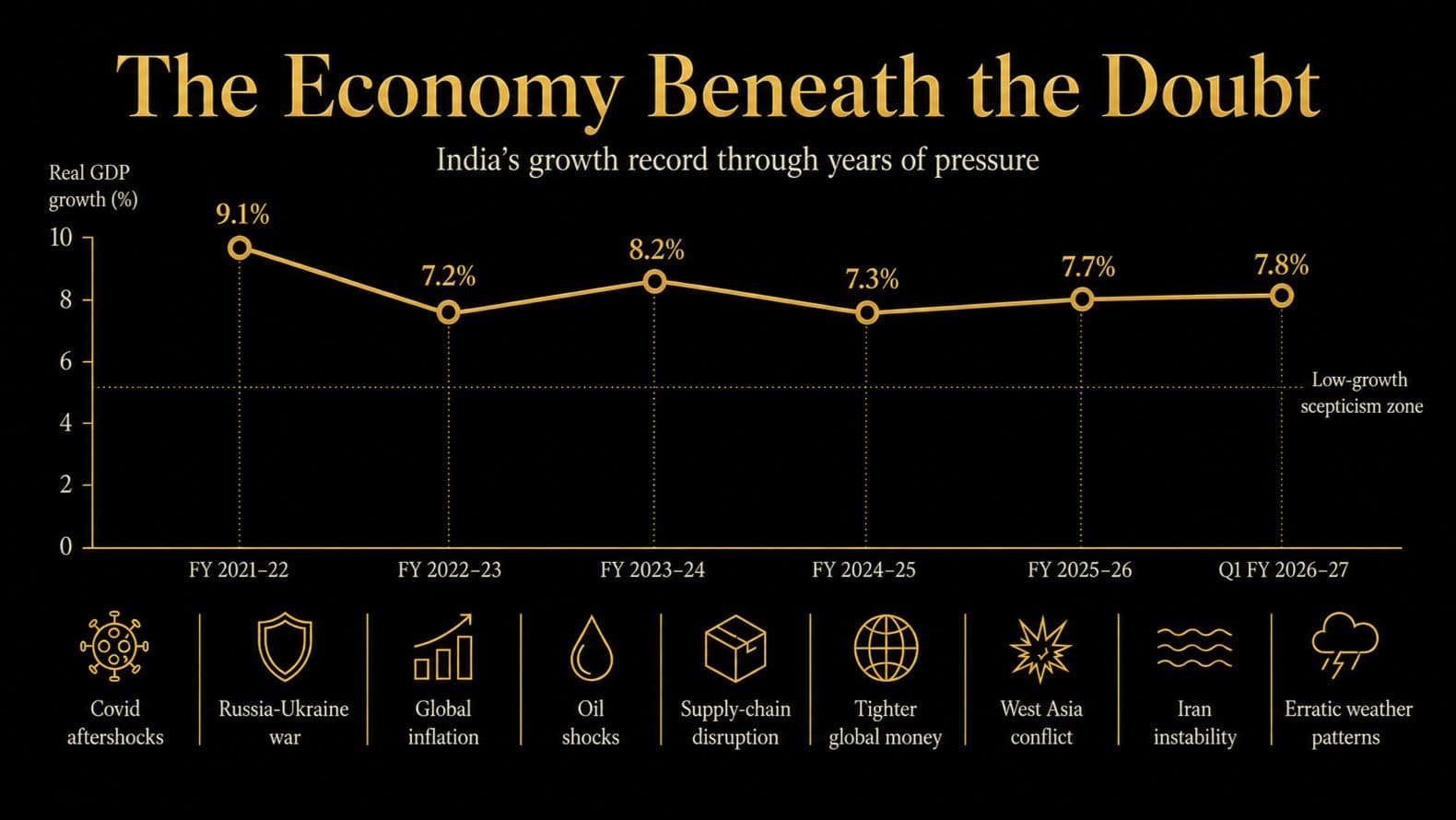
Beyond the 7.8% Headline: What the “Dead Economy” Remark Missed
When confidence in India’s post-Covid recovery was fragile, the then Chief Economic Adviser saw a 7% growth decade ahead. 5 years later, the latest 7.8% Q1 GDP print gives that call sharper context.
August 31, 2026

Can Sugar-Free Chocolate Become the Next Billion-Dollar Better-for-You Food Category?
Sugar-free chocolate, already a USD 2.6 billion global market, is projected to reach USD 4.86 billion by 2034, as better-for-you indulgence moves from niche demand toward mainstream consumption.
August 18, 2026
Industrial Cybersecurity Market: India’s Role In A USD 54.8 Billion Global Cyber-Resilience Opportunity
As factories, utilities & supply chains connect faster, India is emerging as a force in the USD 54.8 billion industrial cybersecurity market, where resilience will define the next industrial edge.
August 6, 2026